
Money laundering detection software: what AML teams should look for
The AML compliance software market has never had more vendors claiming AI capabilities. For compliance teams in the middle of a platform evaluation, that's both an opportunity and a problem. An opportunity because the technology has genuinely improved. A problem because "AI-powered" has become a marketing label that means very little on its own.
When your team is evaluating money laundering detection software, the question isn't whether a platform uses AI. Every vendor pitches it. The questions that actually matter are what the AI does, whether the outputs are defensible to a regulator, and whether your team will still be running it effectively twelve months from now or fighting to keep pace with evolving fraud patterns.
This guide is for compliance leaders who are past the marketing stage and into serious evaluation. Here is what separates money laundering detection platforms that deliver from ones that look good in a demo and fall apart in production.
Money laundering detection actually requires
Before getting into specific capabilities, it helps to be explicit about what AML detection has to accomplish. The goal is not just to flag suspicious activity. It's to flag the right activity, maintain a defensible record of every detection decision, adapt quickly when new typologies appear, and file reports that hold up under exam without consuming a week of analyst time per filing.
Any platform you evaluate should be tested against those requirements specifically, not against a feature list. The vendors that fall short tend to fail on one of two dimensions: they flag too much, producing false positive rates so high that analyst capacity is consumed by noise, or they can't explain their decisions, which creates regulatory exposure that no compliance program can afford.
The best money laundering detection solutions are built to avoid both. Here is what that looks like in practice.
Real-time detection across every payment rail
One of the clearest differentiators between modern and legacy money laundering detection platforms is whether they operate in real-time. Batch-based processing was the industry standard for years. It is no longer sufficient.
Financial crime happens in seconds. APP fraud, account takeover, and structuring schemes designed to stay under reporting thresholds are often completed before a batch job runs. If your detection platform is evaluating transactions hours after they occur, you are catching fraud after the fact, not stopping it at the point where interdiction is still possible.
The standard to hold vendors to: sub-250ms decisioning across every payment rail your institution operates on. ACH, wires, RTP, FedNow, cards, and crypto. If a vendor cannot tell you specifically what their latency is per payment rail, that is a signal worth noting.
Unit21 delivers real-time decisioning at sub-250ms across all of those channels, with transaction monitoring that runs detection logic against every event as it occurs rather than waiting for batch windows. For institutions moving from legacy batch-based systems, the shift to real-time coverage alone changes what categories of fraud are stoppable.
Rules and AI working together, not instead of each other
One of the most persistent false choices in AML technology procurement is the framing of rules versus machine learning. Vendors selling pure-ML approaches pitch rules as legacy and inflexible. Vendors selling rules-only platforms pitch ML as a black box you cannot explain to a regulator. Both framings are incomplete.
The most effective money laundering detection platforms combine them. Rules provide three things that ML alone cannot: immediate response to new typologies (a compliance team can write a rule today based on a single confirmed incident and deploy it by end of week), full transparency into exactly what triggered an alert, and self-service configuration that does not require engineering involvement every time your risk appetite changes.
Machine learning provides what rules alone cannot: pattern recognition across large datasets, the ability to surface anomalies that no one has written a rule for, and systematic optimization of existing rule performance based on observed outcomes rather than manual tuning.
Unit21 treats this as a settled question. Rules are the foundation for detection and remain fully self-service, with no vendor dependency for configuration changes. AI Rule Recommendations analyze rule performance, identify configurations that generate high false-positive rates or stale detection logic, and suggest targeted improvements backed by real alert data. Every recommendation is reviewed and approved by your team before any changes are made. The result is a detection layer that stays up to date without requiring constant manual effort from analysts or engineers.
AI agents that do the investigation, not just surface information
The distinction between AI-assisted and AI-driven investigation tools is where most compliance teams underestimate the operational difference. AI-assisted tools surface information and leave the investigation work to the analyst. An AI agent does the work and hands the analyst a decision to review. The difference in practice is measured in hours per analyst per day, not minutes.

The investigation stage of a full AML case workflow is where the most analyst time goes: pulling transaction history, checking watchlists, expanding entity networks, assembling the evidence package, and drafting the investigation narrative. These are all necessary steps that add up quickly at the volumes compliance teams face today.
Unit21's AI Investigation Agent handles those steps autonomously for every alert. It ingests the alert context, pulls months of transaction history, checks entities against watchlists, evaluates the alert against your configured SOPs and escalation criteria, drafts an investigation narrative in your format, and produces a disposition recommendation with its full reasoning visible, before a human analyst opens the case.
For L1 cases that fit a well-defined pattern, the analyst reviews and approves. For escalations or novel typologies, everything is assembled without manual investigation work. The custom AI agent configuration is tuned to your specific thresholds, narrative format, and escalation criteria rather than a generic template.
This also extends to SAR preparation. SAR filing has historically been one of the most time-consuming parts of AML compliance, typically requiring analysts to gather findings, draft a narrative, and iterate for quality and consistency across the team. Unit21's SAR Filing Agent drafts narratives in the structure your compliance program requires, incorporating investigation findings, entity relationships, and relevant transaction detail, ready for analyst review and approval before submission.
Network intelligence: your own data cannot provide
Every money laundering detection platform learns from your data. The question is whether it also learns from data you do not have access to.
Financial crime does not operate within a single institution. The same bad actors and fraud networks move across banks, fintechs, and crypto platforms. A fraudster confirmed at one institution is almost certainly active elsewhere. If your detection platform is limited to your own transaction history, you are always discovering patterns after they have already reached your customers.
Unit21's Consortium addresses this at the network level. When a fraud team at one institution confirms a bad actor, that signal, anonymized and categorized, propagates across the network. Every other institution benefits from the warning before the actor appears on their platform. The early-warning advantage is most pronounced for emerging typologies: a new pattern identified at one institution today is shared across the network immediately, rather than being rediscovered independently by each institution weeks or months later.
The Consortium currently covers 100+ US-based financial institutions and 80M+ US adults, with a give-to-get model and no raw PII exchanged. It is included at no additional cost for Unit21 customers. The intelligence that flows from it, confirmed bad actor signals, fraud typologies, and entity relationships, is the kind that standalone AI tools built on single-institution data cannot replicate.
Explainability and audit readiness
This is a non-negotiable capability for AML compliance and worth calling out explicitly, because it is where the gap between compliance-grade platforms and compliance-adjacent platforms shows up most clearly under exam.
Every disposition an AI system makes needs to be traceable: what data it accessed, which policy criteria it applied, what it found, and why it recommended what it recommended. A probability score without a supporting rationale is not an answer that holds up under regulatory scrutiny. If a vendor cannot show you clearly how an AI decision is explained and audited, that is a hard stop in your evaluation.
Unit21's AI produces a full reasoning chain for every recommendation. Every action taken during an agent run is logged: data accessed, checks performed, and assumptions made. Analysts can review, override, and document disagreement, and that override history becomes part of the audit trail. The governing principle behind Unit21's AI design applies directly to any AML platform evaluation: if it is not defensible to a regulator, it should not be in production.
Red flags to watch for
The capabilities above define what good money laundering detection looks like. There are also patterns in vendor evaluations that indicate a platform is not ready for production compliance work.
Be cautious of any vendor that cannot explain AI outputs in plain language. Probability scores without supporting rationale are a regulatory liability that grows every time an examiner asks a question the system cannot answer. Watch for platforms that operate on batch processing for core payment rails. If the answer to how quickly a transaction can be detected is measured in hours rather than milliseconds, real-time interdiction is not actually on the table.
Ask whether shadow mode or validation testing is supported before go-live. Any credible money laundering detection solution should let you run new logic against live or historical traffic without acting on it, so you can validate performance before it touches live decisions. If a vendor cannot support this, treat it as a meaningful red flag. And be skeptical of AI-only approaches that position rules as something to eliminate. The flexibility, auditability, and immediate response capability of rules remain essential in any regulated environment, regardless of how sophisticated the AI layer is.
What these capabilities look like in production
The results from compliance teams running Unit21 in production are consistent in direction, though they vary based on alert types, data quality, and how well the platform is configured.
Nexo achieved a 93% reduction in false positives and automated 57% of their alert reviews through AI Agents. Uphold reduced alert review time by 44% and cut SAR preparation time from nearly a week to under 30 minutes. Underdog reduced alert volume by 72% using AI. Service Credit Union cut fraud losses by 70% and prevents over $1M in losses per quarter, saving 2-3 FTEs through automation. Across 62+ institutions, Unit21's AI Agents process 213,000+ alerts per month.
The pattern from the highest-performing deployments: teams that start with a single high-volume alert type, run in shadow mode to validate quality against their actual cases, and expand incrementally consistently outperform teams that try to deploy broadly before the foundation is proven.
Why compliance teams choose Unit21 for money laundering detection solutions
There are platforms that can check some of the boxes above. Unit21 is built to check all of them in a single environment, without requiring engineering resources to keep pace with changing fraud patterns or evolving regulatory expectations.
Three things set Unit21 apart from other money-laundering detection solutions on the market:
- First, the platform is self-service by design. Compliance teams configure their own detection rules, investigation workflows, and escalation criteria without filing a vendor support ticket every time something needs to change. When a new typology appears, you can respond the same day.
- Second, the AI does the work rather than assisting with it. Unit21's Investigation Agent handles the full L1 triage and investigation workflow autonomously, including SAR narrative drafting, producing outputs your team reviews and approves rather than builds from scratch. That distinction is what drives the 44% to 93% reductions in handle time and false positives you see across customer deployments.
- Third, the Consortium provides early-warning intelligence that no standalone platform can replicate. Because Unit21 operates across 100+ institutions, confirmed bad actor signals propagate across the network immediately. Your detection benefits from patterns your own data has never seen.
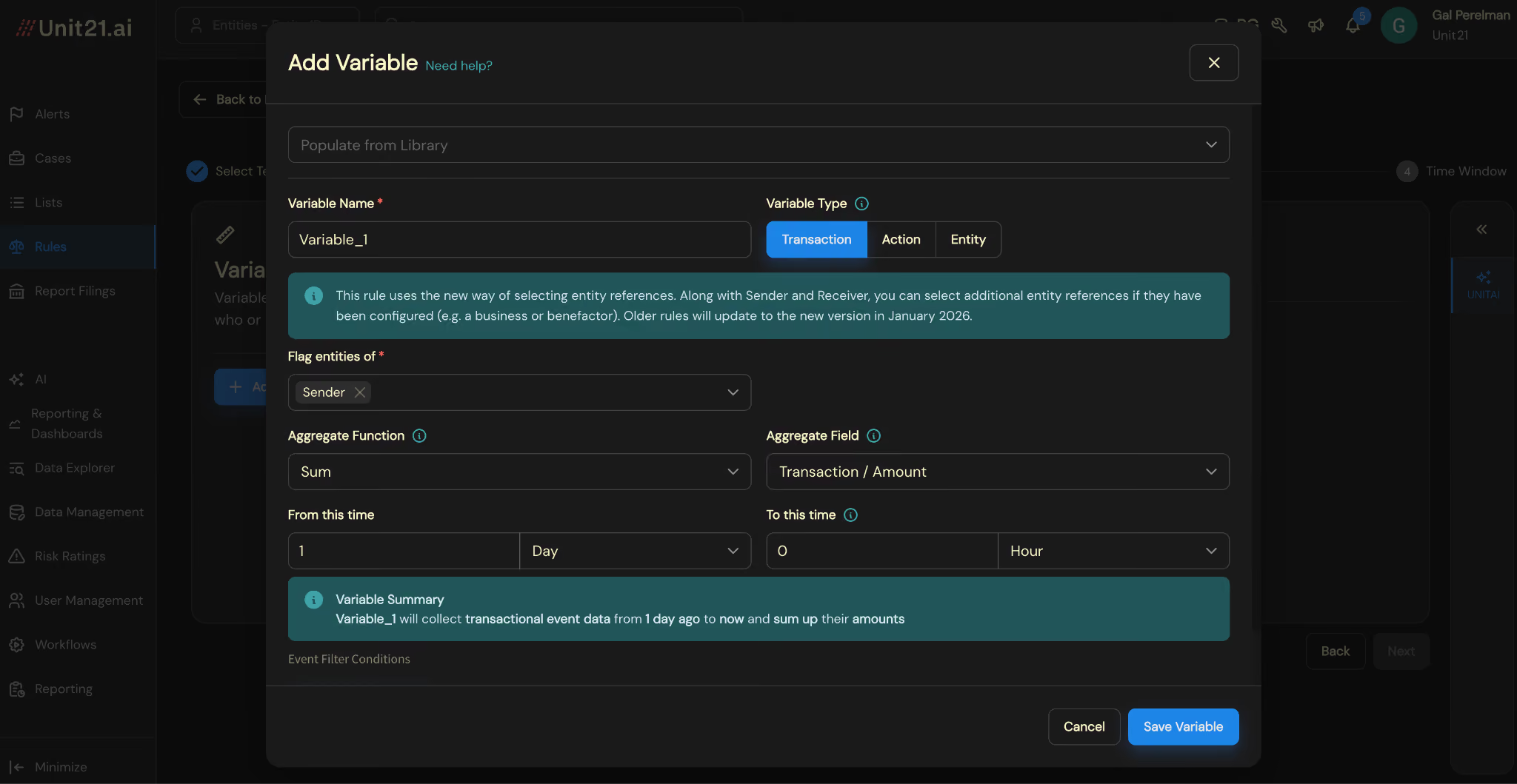
For compliance leaders evaluating options, the practical question is whether a platform holds up under the conditions that actually matter: a regulator asking why a specific alert was closed, a new fraud typology appearing Monday morning, or an analyst trying to clear 200 alerts before end of day. Unit21 is built for all three!
Frequently asked questions
What capabilities should I prioritize when evaluating money laundering detection software?
Start with explainability and real-time coverage. A platform whose AI cannot explain its decisions in a regulator-ready format creates compliance risk regardless of how accurate the underlying model is, and one that operates on batch processing will miss time-sensitive fraud entirely. From there, evaluate whether it combines rules and AI rather than replacing one with the other, whether shadow mode testing is supported before go-live, and whether the platform has access to network-level intelligence beyond your own transaction data.
Can AI-drafted SAR narratives be submitted to regulators?
Yes. Regulators assess SAR quality based on accuracy, completeness, and defensibility, not on whether a human or AI produced the initial draft. AI-generated narratives reviewed and approved by a qualified analyst, backed by a full audit trail, meet the same standard as manually drafted ones. The requirement is a documented human review step before filing and a clear record of the investigation that supports the narrative.
How does network intelligence improve money laundering detection?
Network intelligence means your detection benefits from fraud signals confirmed across multiple institutions, not just your own transaction history. When a bad actor is confirmed at one institution in the network, that signal is shared (anonymized) with all participants. Your platform warns you about actors you have never seen before, based on what the broader network has already learned. For emerging typologies, this typically means detecting a new pattern weeks earlier than you would from your own data alone.
What is the difference between a money laundering detection platform and a point solution?
Point solutions handle one part of the workflow, such as screening, transaction monitoring, or filing, and require integration with other tools for end-to-end coverage. A platform handles detection, case investigation, and regulatory filing in a single environment, with AI that operates across the full workflow. The compliance case for a unified platform is straightforward: every handoff between tools introduces latency, potential data loss, and audit complexity that a single integrated platform eliminates.
What does implementation look like for a money laundering detection solution?
Most teams are operational on their first use case within weeks rather than months. The primary investment is configuration: aligning the AI agent to your SOPs, narrative format, escalation thresholds, and risk appetite. Running in shadow mode for two to four weeks before going live adds confidence without materially extending the timeline. The teams that scale fastest start narrow, validate rigorously, and expand from there.
Conclusion
The money laundering detection software market is crowded, and every vendor pitches AI. The evaluation criteria that actually matter, real-time coverage across all payment rails, hybrid rules and AI detection, agents that do the investigation and SAR drafting work, network intelligence beyond your own data, and glass-box explainability for every decision, are the ones that separate platforms built for regulated environments from ones that look impressive in a demo.
Unit21 was designed for compliance teams operating under real regulatory accountability. The AI does the work, the reasoning is visible and auditable for every recommendation, and the platform is configurable to your SOPs without engineering involvement.
If your team is evaluating money laundering detection platforms and wants to see how this works against your actual alert types and workflows, request a demo with Unit21 →

Gal Perelman is the Product Marketing Lead at Unit21, where she spearheads go-to-market strategies for AI-driven risk and compliance solutions. With over a decade of experience in the fintech and fraud sectors, she has led high-impact launches for products like Watchlist Screening and AI Rule Recommendations.
Previously, Gal held marketing leadership roles at Design Pickle, Sightfull, and Lusha. She holds a Master’s degree from American University and a Bachelor’s from UCLA, and is dedicated to helping banks and fintechs navigate complex regulatory landscapes through innovative technology.