
Crypto AML compliance: why Datos Insights named Unit21 the category winner
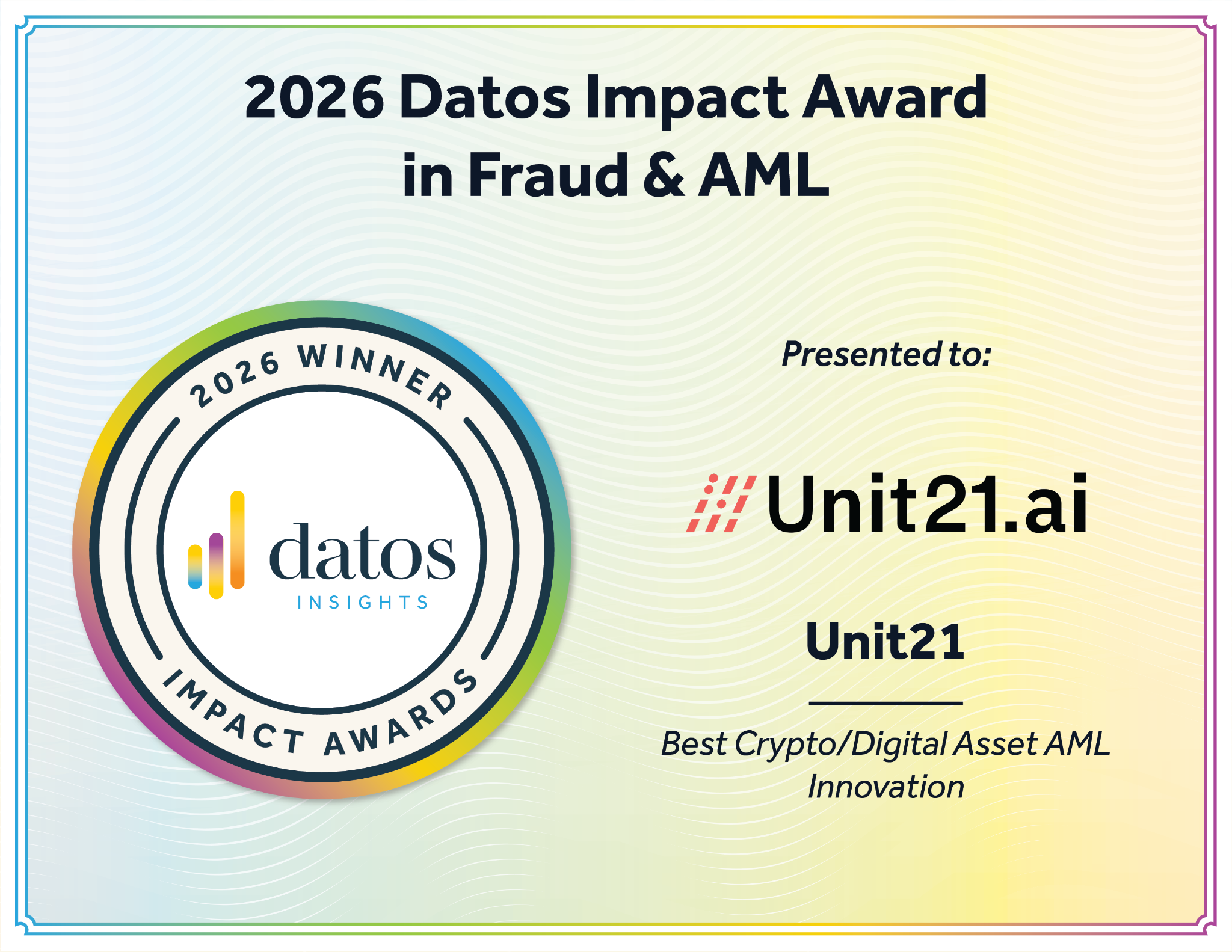
Datos Insights has named Unit21 the winner of its 2026 Impact Award for Best Crypto/Digital Asset AML Innovation, recognizing the platform for unifying on-chain blockchain intelligence with off-chain transaction monitoring, AI-driven investigation, and regulatory filing in a single end-to-end compliance workflow.
The category exists because crypto AML compliance carries a structural weakness that no amount of better on-chain data resolves on its own, and the award went to the work of closing it.
In brief
- Award: 2026 Datos Impact Award in Fraud & AML, winner, Best Crypto/Digital Asset AML Innovation
- Awarded by: Datos Insights, across a program spanning 14 categories
- Recognized for: connecting on-chain intelligence to off-chain monitoring, investigation, and filing in one workflow
- Eligibility bar: production software only, developed after January 1, 2024
- Also recognized: the only company named in both the AML Innovation and Financial Crime Convergence groups
What the award required
Two features of the program shape what the recognition means.
Only production software was eligible. Per the awards announcement, "all nominated innovations were required to be in production and developed within the past two years (after January 1, 2024)." Nothing on a roadmap could be entered. Every capability Datos cited was already running inside financial institutions when it was judged.
The category is a specialist one. Best Crypto/Digital Asset AML Innovation sits in the AML Innovation group, alongside categories for KYC and KYB, transaction monitoring, sanctions screening, and financial crime RegTech. Datos recognized winners and silver medalists across 14 categories in total. Unit21 was the only company named in both the AML Innovation and Financial Crime Convergence groups.
The problem the category exists to solve
Crypto AML compliance has a structural weakness that Datos named directly in its assessment: the on-chain/off-chain split.
Blockchain analytics tools produce excellent on-chain intelligence. Wallet addresses, chain history, counterparty risk scores. What they have not done is connect to the transaction monitoring, case management, and suspicious activity filing workflows a compliance team needs to actually close an investigation. The result, in Datos' words, has been "a fragmented toolset: separate platforms for blockchain analytics, transaction monitoring, case management, and regulatory filing, each with its own data model and its own handoff delay."
A risk score is an input, not a finding. A tool can tell you a wallet has exposure to a sanctioned entity three hops back. It cannot tell you which of your customers sent there, whether they have done it before, whether four other accounts did the same thing that week, or whether any of it rises to a filing. Those are investigation questions, and they need the institution's own data sitting next to the chain data. We walk through that gap in detail in how to manage crypto risk beyond blockchain analytics.
Crypto makes this harder than traditional finance because crypto structures rarely map one account to one customer. Platforms operate shared wallets, subaccounts, and referral cohorts funded from a single source. Mule rings converge on a common wallet. One entity controls multiple registered instruments. None of that is visible to detection logic that evaluates a single transaction against a single account.

What Datos cited, and why each one counted
Datos named the following capabilities in its assessment:
- Bidirectional Chainalysis integration. Chainalysis wallet risk scores and transaction risk signals flow into Unit21 as structured alert inputs, and alert dispositions flow back to Chainalysis to enrich its risk models in real time.
- Why it counted: most integrations are one-way. The return path means your analysts' conclusions improve the signal you receive next time instead of dying inside a closed case.
- TRM Labs wallet screening. TRM risk signals are ingested for real-time monitoring, alert creation, and AI investigations, and can be referenced directly in no-code rule logic.
- Why it counted: it demonstrates the architecture is not built around a single analytics vendor. Risk signals are treated as a class of input, not a bespoke connector.
- Agent-based self-service rules engine for crypto-native types. Detection supports on-ramp, off-ramp, wallet-to-wallet, stablecoin transfer, and exchange-to-exchange transactions, covering typologies including chain-hopping velocity, structured crypto transactions, rapid on-/off-ramp patterns, and exchange-to-exchange layering. Rules can reference Chainalysis or TRM signals directly.
- Why it counted: crypto typologies move faster than engineer-dependent update cycles. A compliance team that has to file a ticket to adjust detection is permanently behind.
- Graph-based rules and network analysis. A visual graph rule builder flags entities linked by a shared wallet address, device, IP address, phone number, or funding source, so several accounts converging funds on one wallet are detected as a ring rather than as unrelated accounts. The case view renders the same connections.
- Why it counted: this is the direct answer to the one-account-one-customer assumption. It is also why a reviewer sees a structure instead of a list of individually unremarkable accounts.
- AI Investigation Agent and Case Agent with crypto-specific tasks. Out-of-the-box tasks cover structuring analysis, on-ramp and off-ramp pattern detection, wallet history review, and sanctions match evaluation, and teams can build custom tasks for their own typologies, chains, product types, and relationships. The Case Agent investigates a full case rather than a single alert, assembling evidence across linked entities.
- Why it counted: the agents carry the work from alert to a reviewable package, which is what removes the manual translation step between the chain and the case.
- Consortium intelligence. A cross-vertical fraud and AML intelligence network spanning more than 100 crypto platforms, banks, credit unions, and fintech firms, covering 100 million unique US individuals. A bad actor flagged at a fintech can appear in the consortium signal at a crypto exchange before that actor transacts.
- Why it counted: no single platform sees enough on its own. Early warning on an entity you have never encountered is intelligence you cannot buy anywhere else.
- Native multijurisdictional regulatory filing. Suspicious activity filing with direct SAR e-filing to FinCEN, STRs to FINTRAC, and automated goAML submissions across 45+ other jurisdictions, with agents producing filing-ready narratives.
- Why it counted: filing is where fragmented toolsets fail most expensively. Ending the workflow inside the same platform that detected the activity is what makes the audit trail continuous.
Datos also noted that the platform generates on-demand reports showing the specific models in use and the results of bias testing, addressing EU AI Act requirements. For platforms operating across North America and Europe, that removes a future compliance question from the evaluation.
Why the timing mattered to the evaluation
This category recognition has a deadline attached to it, and Datos flagged it.
Under the GENIUS Act, signed in 2025, stablecoin issuers must establish full AML programs with enforcement beginning in January 2027. Working backward, an issuer without a program today needs to be operational by the end of 2026. Not selected, not mid-implementation. Running.
That compresses the build for transaction monitoring configured for stablecoin flows, sanctions screening, suspicious activity filing, and the program documentation an examiner will ask for. It is a particularly unforgiving timeline for anyone planning to integrate four vendors and write the glue themselves, which is part of why a single connected workflow was the thing worth recognizing this year.
The results Datos reviewed
The award write-up cited outcomes from named customers:
- Nexo reported a 93% reduction in false positives, with 57% of alert reviews automated by AI Investigation Agents, against a stated internal target of 80%
- Uphold reported 44% faster alert reviews and suspicious transaction report preparation time cut from nearly a week to under 30 minutes, with no engineering resources required for rule modifications
Crypto platforms running on Unit21 also include crypto.com, MoonPay, Circle, Bakkt and Gate US to name a few.
Frequently asked questions
Which 2026 Datos Impact Award did Unit21 win?
Unit21 won Best Crypto/Digital Asset AML Innovation in the AML Innovation group, and was also recognized in the Financial Crime Convergence group for AI-driven innovation across fraud and AML. It was the only company named in both groups.
What did Datos evaluate?
Production software only. Every nominated innovation had to be live inside financial institutions and developed after January 1, 2024. Roadmap items were not eligible.
Do I still need a blockchain analytics provider?
Yes. On-chain intelligence is specialized work, and Unit21 does not replace it. The recognition was for connecting it: Chainalysis and TRM Labs signals feed detection and investigation rather than sitting in a separate tab, and dispositions flow back to improve the signal.
Can detection rules reference on-chain risk scores directly?
Yes. Those signals are available as attributes in the no-code rule builder, so a wallet risk score can drive detection on a linked account or instrument.
How does this handle shared wallets and subaccounts?
Customers, accounts, instruments, and wallets are modeled as linked objects, and graph-based rules traverse those links. Accounts converging on a shared wallet are detected as one structure.
Will AI agents file a SAR without a person reviewing it?
No. Agents produce a recommended disposition, an evidence summary, and a filing-ready narrative. Human review before filing is mandatory by design.
Is this ready for a stablecoin issuer starting from scratch?
Monitoring configured for stablecoin flows, sanctions screening, and SAR and STR filing are live in production today. A packaged turnkey bundle is still in development, so ask about current scope against your timeline.
Where this leaves a crypto compliance team
Datos Insights recognized Unit21 for crypto AML compliance because the platform ends the handoff between on-chain intelligence and the investigation that has to act on it, and because it was doing so in production rather than in a demo.
If you are building toward the 2027 stablecoin deadline, or your analysts are working in two tools to answer one question, that handoff is the thing worth removing first.

Cassie Pallesen is the VP of Marketing at Unit21, bringing over 15 years of B2B marketing experience scaling companies from pre-revenue stages through to IPO. She is a creative and collaborative leader with a proven track record of building high-performing teams and driving strategy in hyper-growth environments.