
Fraud and AML convergence: why Datos Insights recognized Unit21 in AI-Driven Innovation
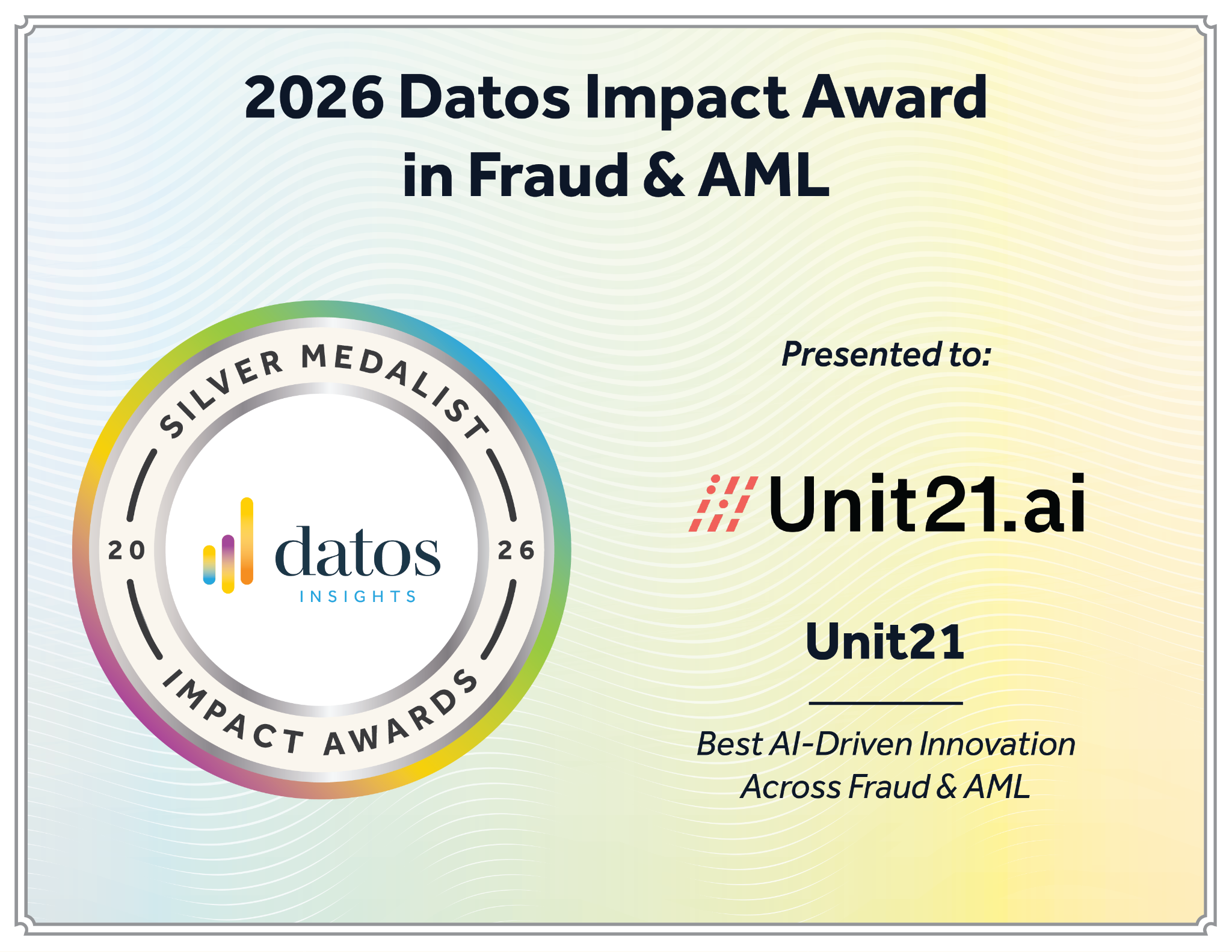
Datos Insights has recognized Unit21 in the Financial Crime Convergence group of its 2026 Impact Awards, for Best AI-Driven Innovation Across Fraud & AML, citing the platform for deploying agentic AI across the full financial crime lifecycle within a unified system.
The category matters as much as the placement. Fraud and AML convergence is not a feature you ship. It is a property of how the data and the workflows are arranged, which is what an evaluation like this can actually test.
In brief
- Award: 2026 Datos Impact Award in Fraud & AML, Financial Crime Convergence group, Best AI-Driven Innovation Across Fraud & AML, silver medalist
- Recognized for: agentic AI running detection, investigation, and filing across both fraud and AML on shared infrastructure
- Eligibility bar: production software only, developed after January 1, 2024
- Notably: the only company named in both the AML Innovation and Financial Crime Convergence groups, and the only fraud and AML operations platform recognized in the AI-Driven Innovation category
- Second analyst view: Chartis Research independently evaluated Unit21 against its agentic AI maturity framework
What the award required, and what it recognized
Only production software was eligible. Per the awards announcement, "all nominated innovations were required to be in production and developed within the past two years (after January 1, 2024)." Roadmap items could not be entered, so every capability Datos cited was already running inside financial institutions when it was assessed.
Unit21 was the only company named in both the AML Innovation and Financial Crime Convergence groups across the program's 14 categories, and the only fraud and AML operations platform recognized in the AI-Driven Innovation category.
Datos summarized the value proposition it evaluated as three claims: the platform reduces analyst workload by automating simple and complex investigation tasks, unifies fraud and AML operations, and delivers auditable AI outputs with full reasoning traces. Those three claims map to the three gaps Datos identified.
The three gaps Datos said the platform addresses
Datos named them explicitly, and they build on each other.
- Alert volume versus analyst capacity. Volume grows faster than teams can hire, and the default response has been to add analysts rather than restructure the work.
- Fraud-AML convergence. In their words: "Fraud and AML operations have operated as separate functions. Different teams, tools, and alert queues managed each domain. This separation can create blind spots. Mule networks detected by fraud teams may be laundering proceeds that warrant AML suspicious activity reporting. Sanctions hits from crypto transactions can inform fraud risk scoring."
- The AI credibility gap. Compliance teams are cautious about AI return-on-investment claims and worried about regulatory defensibility. The second concern is the one that stalls deals, and what is actually holding compliance teams back from AI is rarely doubt that it works.
The split between fraud and AML was never a strategy. AML grew out of regulation, and its metrics are report quality, audit defensibility, and examiner outcomes. Fraud grew out of the P&L, and its metrics are loss rates, approval rates, and conversion. Different mandates produced different teams, vendors, and systems of record. Reasonable at the time. Criminals never organized themselves along that line.
What Datos cited, and why each one counted
The award write-up named these capabilities.
- AI Investigation Agent. Processes alerts autonomously by pulling transaction histories, checking watchlists, tracing entity and network relationships, and analyzing behavioral patterns, then produces a complete investigation package for human review: recommended disposition, evidence summary, and regulator-formatted narrative. At the case level, it consolidates evidence from multiple related alerts into a single recommendation.
- Why it counted: this is the difference between AI that assists and AI that performs. Assistance means the analyst still gathers the evidence and the model summarizes it. Here the evidence arrives assembled, and the case-level consolidation is exactly the shape a converged investigation needs.
- AI Detection Agent. Analyzes alert outcomes to identify rules with high false-positive rates or stale configurations, recommends specific changes with simulated impact before application, and drafts net-new rule candidates in natural language that compile to deterministic SQL-based detection logic.
- Why it counted: it works on the detection layer rather than only the queue, and the simulation step means a proposed change is evaluated before it touches live traffic.
- Agentic Task Builder. Lets customers construct custom agent tasks in natural language that compile to deterministic, auditable code, encoding institution-specific investigation logic without professional services or engineering resources. Two categories are live: Data Analysis tasks that query your own transaction and case data, and Online Search tasks covering adverse media screening, sanctions and watchlist checks, and business verification. Each task is testable against historical alerts before it touches a real queue.
- Why it counted: plain-language descriptions compile to deterministic code rather than being treated as open-ended prompts, so the same workflow produces the same result across runs. Chartis names this same capability, self-service agent building without a vendor engineering ticket, as a Level 4 differentiator in its agentic maturity framework.
- Multimodel orchestration. Models are selected dynamically per task based on real-time benchmark performance, and replacements are validated against evaluation sets derived from historical analyst decisions before deployment.
- Why it counted: no single model stays best at everything, and swapping one in without validating it against your own decided cases is how quality silently regresses.
- Fraud and AML unification. The same agent infrastructure handles both domains, with shared entity data, shared network analysis, and shared investigation context across both.
- Why it counted: this is the claim the category is named after, and it is the one most often asserted without substance. Two modules sharing a login is not convergence.
Datos also cited the platform's use of context engineering, providing models with precisely curated data rather than everything available. Chartis independently elevates context engineering to the single most important differentiator in its own evaluation framework, which is two analysts landing on the same technical point.
Why unification is the load-bearing claim
Genuine sharing changes three things in practice.
A fraud signal becomes an AML input. Your fraud team identifies a cluster of accounts converging deposits on a single funding source. On separate systems, that closes as a fraud case. On shared infrastructure, the same entity graph is what an AML investigator sees, and the structuring pattern gets evaluated for reporting rather than discarded.
An AML signal becomes a fraud control. A sanctions or adverse media hit on a counterparty is not only a filing question. It is a risk attribute you can write fraud rules against, so the next customer transacting with that counterparty is scored accordingly, in real time, before the money moves.
One actor produces one investigation. Where both domains have alerts on the same subject, they resolve into a single case with one evidence trail rather than two analysts independently reconstructing the same story.
The benefit is not only speed, but also consistency. Two teams inside one institution reaching different conclusions about the same customer in the same month is difficult to explain to an examiner. The approach to case management is where the two domains either meet or do not.
Why it qualified as defensible
The credibility gap is the one that decides whether any of it survives contact with an examination, and Datos gave it specific attention.
An examiner does not ask a model to narrate itself. They ask why an alert fired, why it closed, and who decided. Those are questions about decisions and their trail, which makes defensibility an architecture property rather than a model feature.
The architecture separates interpretation from decision. Large language model agents handle interpretive work: reading and contextualizing alert narratives, extracting insight from unstructured data, reasoning across entity relationships, drafting narratives grounded in evidence. Deterministic rules govern compliance-critical decisions: detection thresholds, typology classification, escalation criteria. As Datos put it, "this separation maintains auditability while enabling AI to handle pattern recognition tasks."
The reason to draw the line there is that the two fail differently. A misread narrative gets caught in review. A threshold quietly set by a model does not, and you cannot reconstruct why it was what it was on a given date. This is a sharper version of the rules versus machine learning argument. The answer was never one or the other; it is knowing which decisions belong to which.
Three quality mechanisms govern every agent deployment. Datos listed all three:
- Deterministic output generation. The same input produces the same output every time. This is the mechanism most often missing elsewhere, and it decides whether an audit trail means anything. If rerunning an alert can yield a different disposition, the original was never a record of reasoning.
- Structured outputs defined by explicit schemas. Not free-form generation. A reviewer knows what fields to expect and can spot an omission.
- Validation against evaluation sets built from historical analyst decisions, benchmarked against best-performing analysts rather than average performance. No agent goes live until it clears that bar.
Progressive autonomy controls scope. Autonomy is configurable across five levels, per queue, risk tier, and use case independently, rather than as a global switch. Each expansion is a decision the institution made and can point to, which is what an examiner wants to see: not an absence of automation, but evidence it was scoped, tested, and governed.
Analyst overrides are captured as a product improvement signal, not as training data. There are no automated retraining loops, deliberately, because an agent that quietly changes shape between examinations is one you cannot document. More on the agents themselves is on the AI Agent product page.

The results Datos reviewed
The write-up cited outcomes spanning credit unions, fintechs, and international payment providers:
- Nexo: 93% reduction in false positives, with 57% of alert reviews automated by AI Investigation Agents
- Uphold: 44% faster alert reviews, and suspicious transaction report preparation cut from nearly a week to under 30 minutes, with no engineering resources needed for rule changes
- Underdog: 72% reduction in overall alerts, giving analysts a head start on every case
- Green Dot: high-volume first-line reviews automated while accelerating investigations and maintaining accuracy
A crypto lender, an international payment provider, a sports betting operator, and a banking-as-a-service program, on one platform. That range is the practical argument for convergence: the same infrastructure configured for very different risk, rather than a different product per vertical.
How to pressure-test a convergence claim
Chartis Research's seven evaluation dimensions cover agentic AI generally. These questions are specific to the convergence claim, and they are the ones a shared-infrastructure platform answers differently from two adjacent products.
- Do fraud and AML share one entity resolution layer, or two? Ask to see the same customer object from both sides, in the same session.
- Can a fraud rule reference an AML signal directly? If it needs an export and a reimport, the domains are adjacent, not converged.
- Where do two alerts on the same subject end up? In one case with one evidence trail, or in two queues with two analysts.
- What is in production today, not on the roadmap? Agent washing is real, and this is the highest-yield diligence question in the category. It is also the bar this award applied.
Frequently asked questions
What did Unit21 win at the 2026 Datos Impact Awards? Unit21 won Best Crypto/Digital Asset AML Innovation outright, and was named silver medalist for Best AI-Driven Innovation Across Fraud & AML in the Financial Crime Convergence group. It was the only company recognized in both groups.
What is fraud and AML convergence? Running fraud and AML detection, investigation, and reporting on shared infrastructure, so entity data, network analysis, and case context are common to both. The test is not whether one vendor sells both. It is whether a conclusion reached on one side is visible and usable on the other without an export.
Is convergence just one vendor for both fraud and AML? No. Two modules sharing a login is not convergence. The test is whether entity data, network analysis, and case context are genuinely shared, so a conclusion on one side is visible and usable on the other.
Do we have to merge our fraud and AML teams? No. Both keep their mandates and metrics. What changes is that they stop working from separate versions of the same customer, and each side can see what the other found.
Do AI agents replace analysts? No. Agents take the assembly work: pulling history, checking watchlists, tracing relationships, drafting the narrative. Analysts review, approve, or modify. Human review before filing is mandatory by design.
How do you prove an agent's output to an examiner? Every step is visible and traceable, every conclusion is tied to evidence, and thresholds and typology classification sit in explicit rules rather than in a model. The examiner reviews the rule logic and the evidence trail, as they would for a human investigation.
Where should a team start? One alert type, one domain, agents in a review-required configuration. Validate against your own decided cases, then widen. Progressive autonomy is a per-workflow setting, not a global switch.
What the recognition comes down to
Datos Insights recognized Unit21 in a convergence category because the same agent infrastructure runs fraud and AML on shared entity data, network analysis, and case context, and because the AI sitting on top of it is bounded tightly enough that every decision it participated in can still be explained.
Convergence does not happen on an org chart. It happens in the data model, and it only holds up if the boundaries around the AI were drawn before the automation was switched on.

Cassie Pallesen is the VP of Marketing at Unit21, bringing over 15 years of B2B marketing experience scaling companies from pre-revenue stages through to IPO. She is a creative and collaborative leader with a proven track record of building high-performing teams and driving strategy in hyper-growth environments.