
AI agents for case investigations: What changes and what stays the same
Cases are where investigations slow down. An alert is one signal. A case is the whole story: several alerts attached to it, more entities to research, more history to reconstruct, and more context to hold in your head at once. It is the most time-consuming part of the workflow, and for most teams it has been the hardest part to speed up without cutting corners.
This is exactly where AI agents for case investigations change the math. The same agents that already triage your alerts now run on the case itself, so the evidence-gathering is finished before an analyst opens it. Below is what that looks like in practice, what stays the same, and how to set it up.
How alert agents work today
If your team already uses agents on alerts, this will be familiar. Across more than 100 financial institutions and fintechs, Unit21's agents handle L1 triage automatically. When an alert comes in, an agent runs a set of validated investigation tasks against it: Event Analysis, Online Research, Adverse Media, Network Analysis, and Prior Activity. It gathers the evidence, structures it, and summarizes what it found, so the analyst starts from a finished work-up instead of a blank screen.
That approach is proven. The natural next question from compliance and fraud teams has been simple: if it works on alerts, why not on cases?
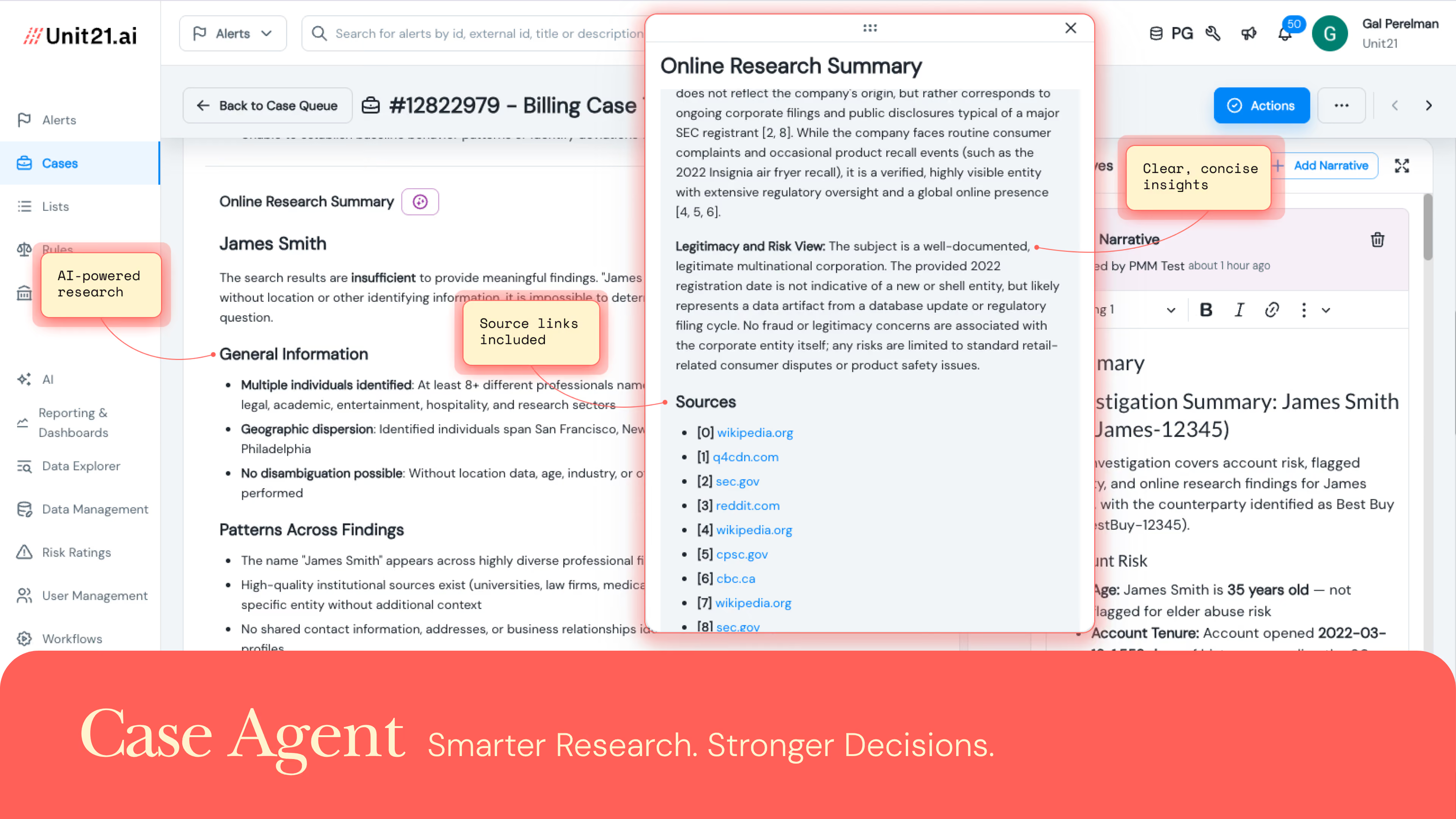
What AI agents for case investigations actually do
Case investigation AI runs the same validated tasks, but on the case rather than a single alert. There is nothing new for your analysts to learn and nothing unproven in the workflow.
Two things make the case version different.
First, it runs automatically on the queue. Assign an agent to a case queue and turn on auto-run, and it investigates every case that enters that queue. This is the same auto-run logic you already use on alert queues, so there is no button to push and no analyst effort to trigger it.
Second, and most importantly, it synthesizes across alerts. A complex case can have half a dozen alerts attached to it. Historically, someone had to open each one, read the findings, and stitch them into a single coherent picture. Automated case review does that work up front. The agent produces one case narrative that pulls together the evidence from every attached alert, plus case-level findings, in one place.
The result: an analyst opens a case and the digging is already done. They read the narrative, override anything their judgment flags, and make the decision. The agent handles the legwork; the human handles the call.
This applies to both fraud and AML programs. Whether a case originates from a fraud signal or a money-laundering typology, the agent runs the same investigation tasks and produces the same structured narrative.
What stays the same
What does not change matters as much as what does.
This is investigative AI, not autonomous decisioning. The agents gather and synthesize evidence. They do not take actions, they do not close cases, and they do not file anything. A human stays in the loop on every decision.
Every output is explainable and built to hold up to a regulator. There is no black box producing a verdict you cannot trace. Each finding shows its work, with a complete and auditable record at every step of the investigation. That is the standard your team and your examiners already expect, and case agents hold to it.
And because the underlying tasks were validated on alerts long before this rollout, you are extending a workflow your team already trusts rather than adopting something untested.
How to set up an agent on a case queue
Setup mirrors what you already do for alerts. Assign the agent to a case queue, choose the tasks you want it to run, and enable auto-run. From that point, every case entering the queue is investigated automatically, with the narrative ready before an analyst clicks in.
Most teams start with a single high-volume queue, confirm the output matches what their analysts expect, and expand to additional queues from there.
The full investigation loop
Alert review was the first step. Case review is the rest of it.
Most platforms automate one slice of the workflow. Unit21 is building toward AI that supports the work across the full investigation lifecycle, from the first alert through case investigation, with an auditable record the whole way. AI agents for case investigations are the next major step in that direction.
You can also watch our AI risk infrastructure in action to see how Unit21 runs the full financial crime lifecycle.

Gal Perelman is the Product Marketing Lead at Unit21, where she spearheads go-to-market strategies for AI-driven risk and compliance solutions. With over a decade of experience in the fintech and fraud sectors, she has led high-impact launches for products like Watchlist Screening and AI Rule Recommendations.
Previously, Gal held marketing leadership roles at Design Pickle, Sightfull, and Lusha. She holds a Master’s degree from American University and a Bachelor’s from UCLA, and is dedicated to helping banks and fintechs navigate complex regulatory landscapes through innovative technology.