SAR narrative automation: How to draft defensible SARs with AI without losing accountability
Writing the narrative is the part of a SAR that examiners actually read, and the part that slows filings down the most. SAR narrative automation promises to fix that: draft the story faster, more consistently, and with less senior-analyst rework. But a suspicious activity report is a regulator-facing evidentiary document, not a business summary, so the bar is different. Done wrong, automating SAR narratives trades speed for exam risk. Done right, it removes the writing burden without touching the accountability. Here is what "done right" looks like, and what changed for us this week.
Why the narrative is the real bottleneck
Most analysts can spot suspicious activity. Far fewer were ever trained to write it up the way a regulator expects. That gap is where SAR programs lose time: inconsistent drafts, heavy rework by senior staff, and filings that sit in a queue while someone rewrites the "why."
The narrative carries the weight of the whole filing. It has to explain, in plain language, what was suspicious and how you know: the who, what, when, where, why, and how. When that story is thin, conclusory, or disconnected from the underlying transactions, an examiner notices. And when every analyst writes it differently, quality becomes a coin flip.
What a defensible SAR narrative actually needs
Before automating anything, it helps to be precise about what a good narrative contains. Regardless of who, or what, drafts it, a SAR narrative should:
- Answer the 5 W's and the H. Who is involved, what happened, when, where, why it's suspicious, and how the activity occurred.
- Name the typology. Structuring, layering, funnel accounts, mule activity. Say what kind of suspicion this is, not just that something looked "unusual."
- Cite the evidence. Every claim should trace back to a specific transaction, entity, or account in your source systems. Conclusions without evidence don't survive an exam.
- Stay objective and lead with the important facts. Use the inverted-pyramid structure: the material findings up top, supporting detail below.
- Be reproducible. Another investigator, or an examiner, should be able to follow the same trail to the same conclusion.
Any approach to SAR narrative generation that can't hit these consistently isn't saving you time. It's deferring the rework.
Where AI SAR narrative drafting goes wrong
It's easy to point a language model at case data and get a narrative out. It's much harder to get one that's accurate and verifiable. That's the trap most teams hit.
Ungrounded models invent details, smooth over gaps, or state conclusions the evidence doesn't support. A black-box tool that produces fluent prose with no traceable link to the underlying transactions is worse than a blank page. It looks finished, so mistakes are easy to miss and hard to defend. If you can't show an examiner why the narrative says what it says, the automation has created a liability, not a filing.
What good SAR narrative automation actually requires
The difference between a demo and a defensible program comes down to a few non-negotiables. Effective SAR narrative automation should be:
- Grounded in the case evidence. Every statement traces back to real entities, transactions, and investigative findings, not the model's imagination.
- Explainable. The reasoning, sources, and assumptions are visible and auditable, so you can defend each line.
- Human-in-the-loop by default. The system drafts; a qualified analyst reviews, edits, and signs. The accountability never moves.
- Consistent to your standards. Narratives follow your format, your typology language, and your QA expectations across the whole team.
- Testable before it's trusted. You should be able to run the approach against historical cases and see how it performs before it ever touches a live queue.
Used inside those limits, automating SAR narratives shifts analysts from writing to reviewing, which is where the throughput gain comes from.
Introducing the Unit21 SAR Agent
This week we made the SAR Agent generally available, and it's built on exactly those principles.
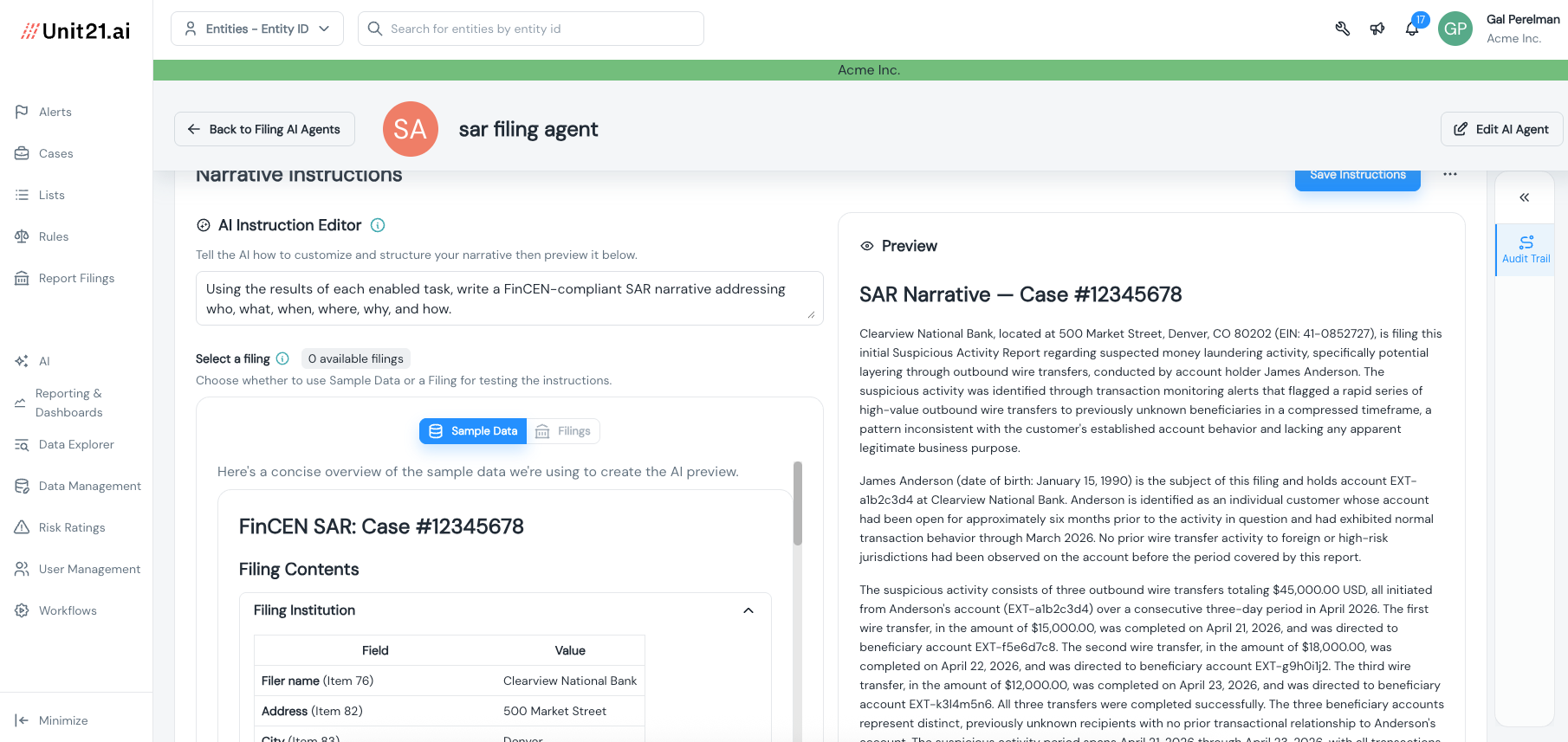
The SAR Agent does two things. First, it drafts a custom SAR narrative for each case, grounded in the case evidence and written in your format, ready for an analyst to review and approve. Second, it extracts the key information from the filing, the figures, dates, and details, so a completed SAR becomes structured, usable data instead of trapped text.
A note on scope, because precision matters here: the SAR Agent drafts and extracts. It doesn't file for you. Direct SAR filing and FinCEN field population are handled by the Unit21 platform as separate steps, so the agent does the writing work, and your team stays in control of what gets submitted.
The SAR Agent is also the final piece of an investigation agent that now runs end-to-end. The same agent triages the alert, investigates the case, and drafts the SAR, carrying context and a full audit trail the whole way. One system, not three tools stitched together.
You choose how much autonomy, and you can prove it first
Trust in compliance is earned, not defaulted. The SAR Agent runs on a five-level autonomy ladder, configurable per queue:
- L0. No AI; the analyst does everything.
- L1. The agent stays on standby and won't run until an analyst triggers it.
- L2. The agent prepares the work; a human clicks to act.
- L3. The agent proposes a disposition; the analyst approves or overrides.
- L4. The agent auto-closes false positives on defined, low-risk case types.
You never have to start at the top. And before any agent touches a live queue, you can backtest its narratives and tasks against historical alerts to see how it performs. Every decision is explainable, every output is auditable, and customer data is never used to train the models.
The result is what SAR narrative automation should have meant all along: analysts spend their time on judgment, not the blank page, teams running the agent see investigations up to 80% faster, and accountability stays exactly where the regulator expects it, with the human who signs.
See the SAR Agent in action. Book a walkthrough and see how AI-drafted, evidence-grounded SAR narratives fit into an end-to-end investigation your team controls.

Gal Perelman is the Product Marketing Lead at Unit21, where she spearheads go-to-market strategies for AI-driven risk and compliance solutions. With over a decade of experience in the fintech and fraud sectors, she has led high-impact launches for products like Watchlist Screening and AI Rule Recommendations.
Previously, Gal held marketing leadership roles at Design Pickle, Sightfull, and Lusha. She holds a Master’s degree from American University and a Bachelor’s from UCLA, and is dedicated to helping banks and fintechs navigate complex regulatory landscapes through innovative technology.