
From Noise to Precision: Watchlist Screening Solutions for 2026
For many compliance teams, watchlist screening remains one of the most frustrating and underperforming parts of the risk stack.
Legacy tools generate high volumes of false positives, forcing analysts to spend hours reviewing alerts. Whether screening for sanctions, PEPs, or adverse media, teams often face a difficult choice: maintain compliance accuracy or deliver a smooth customer experience.
Why? Most watchlist screening solutions weren’t built for speed, flexibility, or scale. Rigid logic, outdated list matching, and disjointed flows across onboarding, ongoing monitoring, and payments make screening an operational tax rather than a growth enabler.
Top Problems with Legacy Watchlist Screening Software
Modern financial institutions face increasingly complex risk signals. Yet legacy watchlist screening software often fails to keep up. Common challenges include:
- Fragmentation: Separate systems for onboarding, ongoing monitoring, and payment screening create gaps and inconsistencies.
- Inflexible Rules: Hard-coded thresholds, fuzzy matching without transparency, and generic list logic generate excessive noise.
- Manual Overload: Analysts spend hours triaging false positives with little insight into why a name triggered an alert.
- Lack of Control: Teams have limited ability to fine-tune list selection, match logic, or screening thresholds by segment or jurisdiction.
It’s clear: Aside from adding AI, reducing alerts requires redesigning the screening architecture from the ground up.
What Modern Compliance Teams Actually Need
Today’s compliance leaders need strategic, intelligent infrastructure that reduces risk without slowing growth. An effective watchlist screening solution in 2026 should follow four key principles:
1. Unified Screening Across the Lifecycle
Screening should not be siloed by function. Whether it’s onboarding a new customer, monitoring an existing one, processing a payment, or performing a one-off vendor check, the same logic should apply consistently. A unified screening suite eliminates the need for separate systems and duplicate reviews.
2. Configurable Logic That Reflects Real Risk
Every organization has different policies, thresholds, and risk tolerance. Compliance teams need full control over how screening is performed—including list selection, match rules, and segment-specific filters. This level of configurability is essential to move from generic alerts to signals that matter.
3. Real-Time Speed at Scale
Batch processing alone can’t keep up with real-time payments and rapid onboarding. At the same time, real-time screening must be built for high volume without introducing latency or errors. A hybrid architecture that supports both batch and low-latency APIs gives teams the flexibility they need.
4. Transparent, Explainable AI
AI should assist human decision-making, not obscure it. Compliance teams need to understand why an alert was triggered and how the system reached its conclusion. Explainability builds trust, supports audits, and ensures decisions remain aligned to internal policies and external regulations.
Introducing Unit21’s Watchlist Screening Software and Solutions
Unit21’s Watchlist Screening Suite was built to solve the exact challenges outlined above. Rather than offering yet another point solution or bolt-on module, it delivers a unified, flexible, and transparent approach to screening across the full customer lifecycle.
What It Covers
The suite supports four core screening use cases in one platform:
Onboarding: Real-time screening via API during account creation, designed to keep customer acquisition smooth without compromising controls.
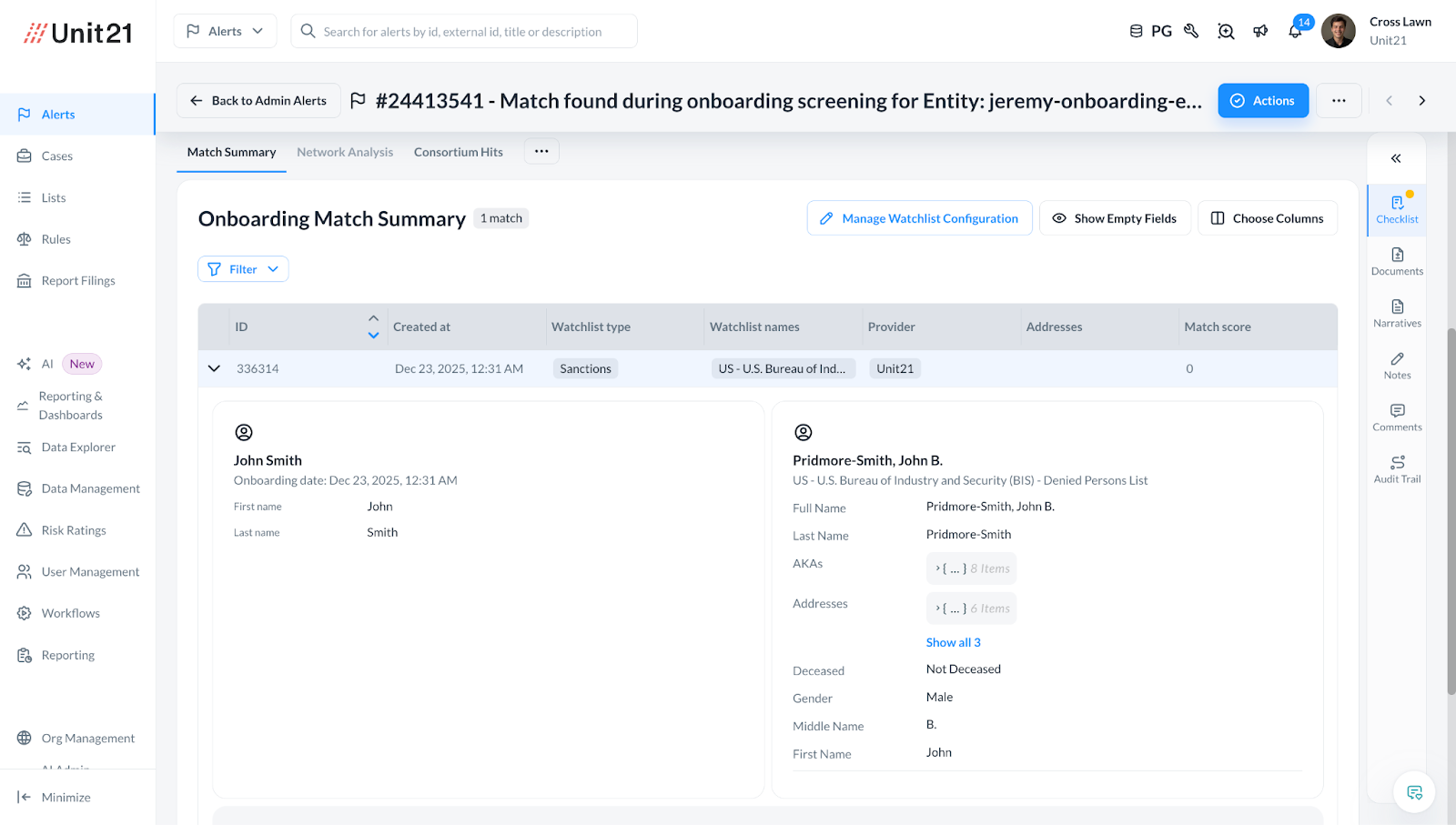
Ongoing Monitoring: Daily batch rescreening with configurable rules and filters to catch new risks while reducing operational noise.
Payment Screening: Real-time scanning of transactions using low-latency pipelines that support high-volume formats.
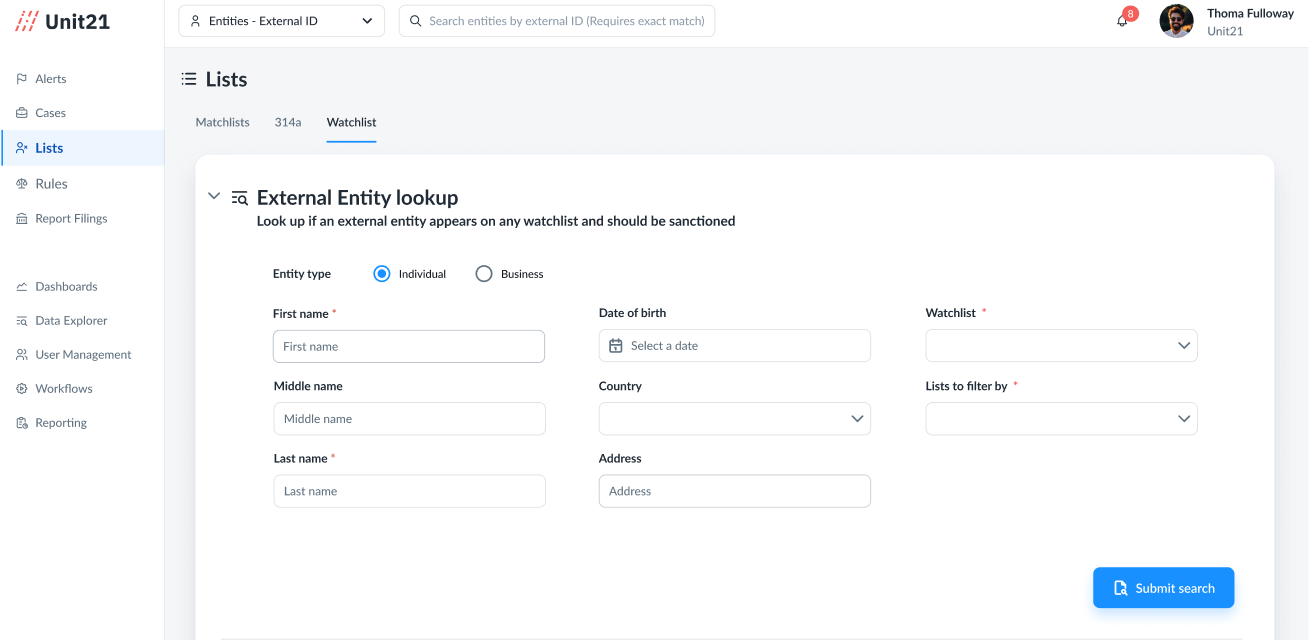
Ad Hoc Checks: Manual lookups for employee, vendor, or investigative scenarios with full audit trail and history.
How It Works
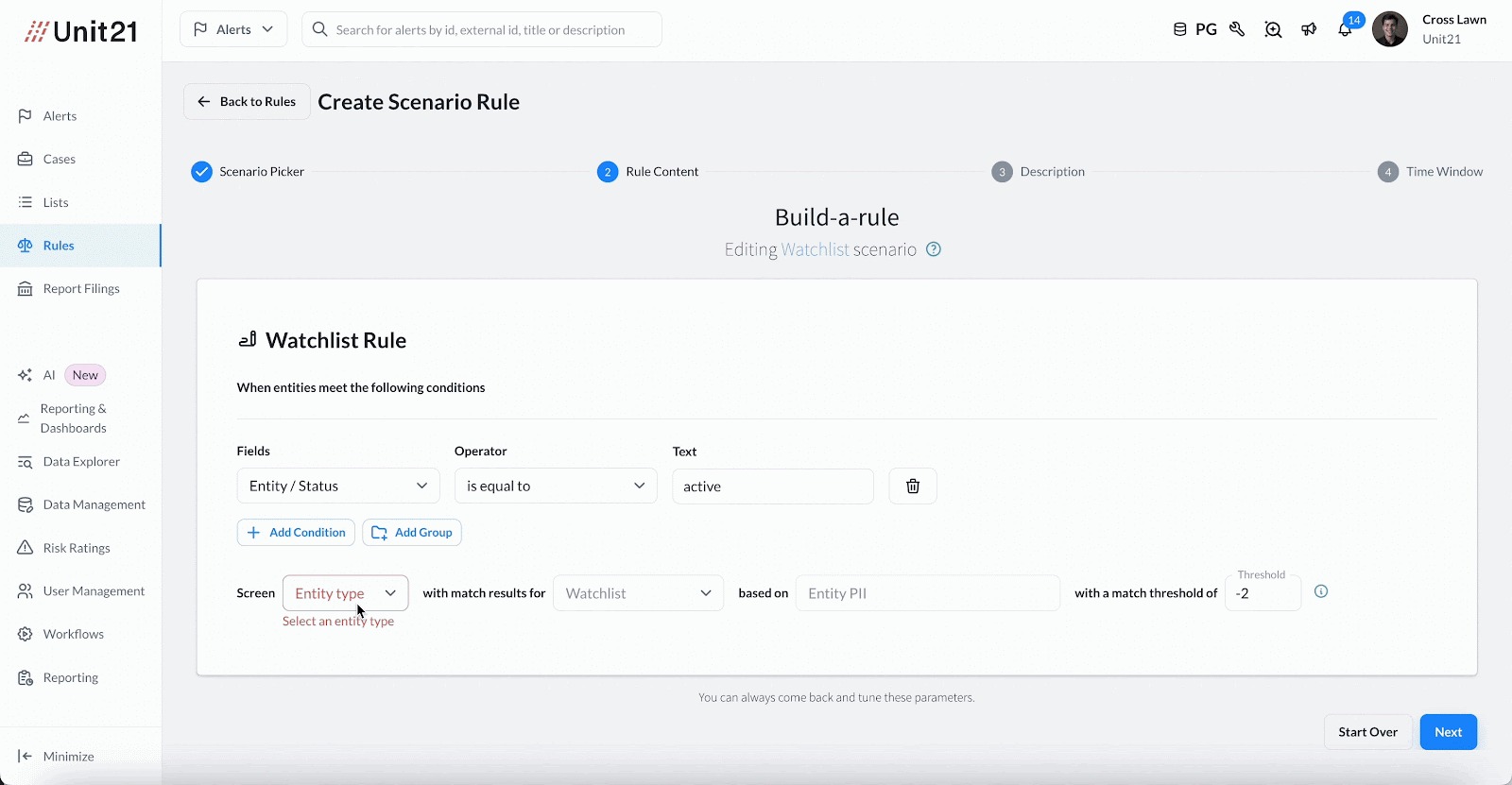
At the core of the suite is a highly configurable screening engine. Teams can:
- Adjust match thresholds
- Apply list targeting down to the field level
- Screen against our weighted scoring model to create alerts
This reduces false positives and improves operational efficiency. The real-time alert pipeline handles everything from a single onboarding application per second to thousands of payments per minute without performance tradeoffs.
Explainable AI: Smarter Screening with the Sanctions Agent
Not all AI is created equal. Many compliance tools claim to use machine learning, but still operate like black boxes, leaving analysts in the dark about how decisions are made and forcing them to manually verify everything.
Unit21 takes a different approach. The Watchlist Screening Suite includes an embedded AI feature called the Sanctions Agent, designed to assist investigators without removing their oversight.
How It Works
- Breaks down the components of a match, field by field
- Provides natural language summary and explanations
- Offers side-by-side comparisons between the entity and the watchlist
This empowers analysts to focus on genuine risks rather than sifting through false positives. AI never replaces human judgment as decisions remain fully auditable and transparent.
7 Key Benefits of a Unified Watchlist Screening Solution
A well-designed watchlist screening software improves accuracy, efficiency, and scalability. Unit21’s suite offers:
- One Suite, No Gaps: Handle onboarding, ongoing monitoring, payments, and ad hoc checks in one platform.
- Consistent Rules Across Workflows: Shared logic reduces maintenance and ensures alignment with internal policies.
- Precision-Driven Screening: Custom thresholds, entity-level filtering, and list scoping focus on true risk.
- Real-Time Scale: Low-latency APIs and batch pipelines support high-volume operations without performance tradeoffs.
- AI That Assists, Not Replaces: The Sanctions Agent reduces review time while keeping analysts in control.
- Lower Total Cost of Ownership: Fewer false positives and less manual work decrease compliance costs.
- Optional Interoperability: Integrates seamlessly with Unit21’s transaction monitoring and case management tools.
Preparing for 2026 and Beyond
Watchlist screening has long been treated as a compliance obligation. But forward-thinking teams are beginning to see it differently—not just as a gatekeeper, but as a strategic layer in the customer journey and risk lifecycle.
With unified, configurable, real-time, and explainable watchlist screening software, teams can reduce operational friction, improve regulatory confidence, and scale confidently with global expansion. Unit21’s Watchlist Screening Suite is built for this future, helping compliance teams make faster, smarter decisions without sacrificing oversight.
Ready to See Our Watchlist Screening Software in Action?
Join our upcoming live session on Tuesday, January 20th at 10:00 AM PST to learn how top fintechs and financial institutions are modernizing their screening approach.
We’ll cover:
- How to reduce false positives with smarter logic
- How explainable AI assists without removing control
- How unified screening creates consistency and lowers costs
Reserve your spot for our upcoming webinar on our Watchlist Screening suite.

Gal Perelman is the Product Marketing Lead at Unit21, where she spearheads go-to-market strategies for AI-driven risk and compliance solutions. With over a decade of experience in the fintech and fraud sectors, she has led high-impact launches for products like Watchlist Screening and AI Rule Recommendations.
Previously, Gal held marketing leadership roles at Design Pickle, Sightfull, and Lusha. She holds a Master’s degree from American University and a Bachelor’s from UCLA, and is dedicated to helping banks and fintechs navigate complex regulatory landscapes through innovative technology.