
How to investigate an account takeover alert: an analyst checklist
Consider an alert that lands at 9:40 on a Monday. A member who has logged in from the same phone in Ohio for three years signed in overnight from a new device, changed the email on file, and scheduled an ACH transfer for tonight. It looks like an account takeover. It could also be a member who bought a new phone, moved, and is paying their contractor.
The analyst has a few hours, maybe less, to tell the difference. Freeze too fast and you lock a real customer out of their money. Wait too long and the transfer clears.
This checklist walks through that investigation step by step. It draws on conversations with fraud teams at banks, credit unions and fintechs about how they actually work ATO alerts, plus the regulatory rules that apply once you confirm one.
The short version
- Contain first if money is about to move. A temporary hold buys time; a cleared wire does not come back.
- Rebuild the timeline of logins, devices, IPs and profile changes before you look at transactions.
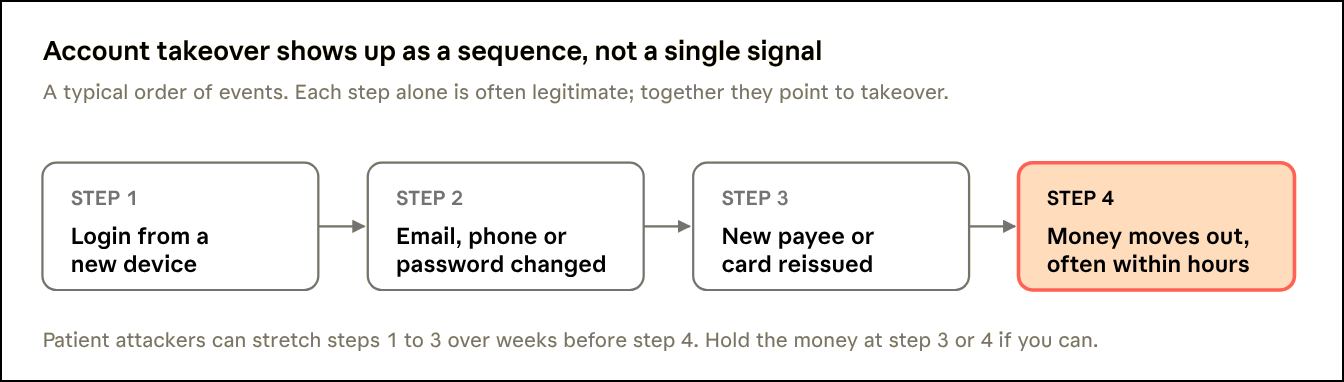
- Look for the sequence, not a single signal. A new device alone is noise. A new device, then a contact change, then a new payee is a pattern.
- Check for links to other accounts that share the device, IP or payee.
- Verify with the customer through contact details from before the change, never the new ones.
- Decide, act and document: release, restrict or close, then handle Reg E claims and the SAR decision.
The investigation at a glance

The order matters. Containment comes before analysis when money is moving, because a temporary hold costs a good customer a few minutes and a cleared transfer may cost everyone the funds. Verification comes after the timeline and link checks, because you want to know what to ask before you call.
The checklist, step by step
1. Decide whether to contain now
- Is a transfer, wire, card order or payee addition pending or scheduled?
- Can you hold that one action rather than freeze the whole account?
- Has the customer been locked out of their own login or contact details?
If money is about to leave, hold it first and investigate second. Transaction-level holds are kinder than account freezes, and one bank fraud lead told us that moving from account freezes to transaction-level controls "has gotten a lot better" for exactly that reason.
Speed matters in both directions. One crypto platform set itself a target of reviewing ATO holds in 15 minutes or less, "so that people aren't locked out of their accounts" when the alert turns out to be a false positive.
2. Rebuild the timeline
- Logins: time, device, operating system, browser and user agent, IP address, ISP and location
- Authentication: which challenges were presented, and which were passed or failed
- Profile changes: email, phone, mailing address, password, MFA method, linked accounts
- Money movement: new payees, first-time rails, card reissues, limit changes
Put these in one sequence. ATO rarely shows up as one event; it shows up as an order of events. A credit union investigator walked us through the pattern they look for: "all I need to see typically is an IP address change, an ISP change, a device change," all within about a week. The same team found that plotting login locations on a map made ATO investigations "immensely easier" than scanning a list of IP addresses.
Watch out for: a passed MFA challenge is not proof of a legitimate login. That same credit union sees fraudsters socially engineer members into reading out the SMS code, so the session passes the challenge and still belongs to the fraudster. Also watch for patient attackers. The team described a case where the fraudster logged in quietly for over a month until the risk scores on those sessions turned green, and only then started moving money.
3. Compare activity before and after the change
- Is this the first time the customer has used this payment type or rail?
- Is the payee new, and was it added after the profile change?
- Does the amount or timing break the customer's pattern (a balance drain, a transfer scheduled for tonight, a dormant account suddenly active)?
- Did someone order a new card or change the shipping address?
The classic sequence is a contact change followed quickly by money out. One investigator described it as "some kind of PII change, and then they're transferring out money."
4. Look for links to other accounts
- Is the device or browser fingerprint seen on other customers' accounts?
- Are several users logging in from the same IP address in a short window?
- Is the receiving account or wallet getting funds from other customers too?
One investment app runs a daily check for five or more users sharing an IP address. Its fraud analyst told us the true positive rate is not the highest, but when it hits, it tends to find larger fraud rings. A marketplace fraud lead described tracing one ring across hundreds of accounts, which is why linked-account checks belong in every ATO investigation, not just the big ones.
Watch out for: IP addresses on cellular networks change constantly. A veteran fraud strategist told us IP is useful "except in very small windows of time," so weight a device match more heavily than an IP match.
5. Check signals from outside your own data
- Was the phone number recently ported or SIM-swapped?
- Is the new phone number a VoIP number?
- Is the new email address brand new, or tied to other accounts?
- Has the customer appeared in a known breach or credential dump?
SIM swap and porting checks matter most when your step-up challenge relies on SMS. The same strategist explained that porting data and SIM change indicators are available from carrier data aggregators, and his team checks them on risky transactions.
6. Verify with the customer
- Contact them through details from before the change: the old phone number or email, or a secure in-app message
- Ask open questions about the specific activity, not yes-or-no questions
- Ask whether anyone has contacted them claiming to be from your institution
Never call the new number on file; if the account is taken over, you are calling the fraudster. Also expect a coached victim. The strategist also noted that when a customer is being socially engineered in real time, they can answer most of the questions an agent asks, because the fraudster is feeding them the answers. Another fraud leader described the reverse failure, which he called "catch and release": a support agent handing account access straight back to a fraudster who called in.
7. Decide, act and document
- Release, restrict or close, with the reason written down
- If confirmed: end active sessions, reset credentials, restore verified contact details, block the device
- Recall or stop payments where possible
- Start the Reg E claim if the customer reports unauthorized transfers
- Make and document the SAR decision
The next sections cover the decision and the regulatory steps in detail.
Signals that separate ATO from a legitimate change
Many ATO alerts turn out to be false positives. People buy new phones, travel, change email providers and pay new contractors. No single signal settles the question, and fraud teams told us the same thing repeatedly: a risky session on its own creates "tons of false positives," so they look for combinations. One credit union only acts on a risky login when it is paired with transfer activity.
The browser row comes from the fraud strategist we spoke with: a browser version that goes backwards, or a cookie the legitimate customer has never used, can point to a fraudster replaying stolen session data. For more signals, see our guide to account takeover red flags.
Deciding and acting: contain, restore, report
If the customer confirms the activity
Release the hold, record what they told you and how you verified them, and consider whether the rule that fired needs tuning. A released alert with a clear note is useful evidence later, both for tuning and for any examiner who asks why you let it go.
If it is account takeover
- Stop the bleeding. End all active sessions, block the device, cancel pending payments and request recalls on anything already sent.
- Give the account back to the real owner. Reset credentials, restore the original contact details, and re-enroll MFA through a verified channel.
- Check the customer's device too. One crypto platform's fraud team walks victims through getting their computer cleaned before lifting restrictions, because a compromised device will let the fraudster straight back in.
- Do not punish the victim. The same team told us they used to offboard customers who had been taken over, and changed course: "we're not going to punish victims for being victims."
- Sweep for related accounts that share the device, IP or payee you found in step 4.
Reg E: when the customer reports unauthorized transfers
For consumer accounts at US institutions, ATO losses usually fall under Regulation E. A few points analysts should know:
- ATO transfers count as unauthorized, even when the customer was tricked into sharing their credentials. The CFPB's EFT FAQs say transfers made by a fraudster who obtained access by hacking, or by deceiving the consumer, meet the definition of an unauthorized EFT.
- Customer negligence does not raise their liability. The same FAQs say negligence cannot be used to impose more liability than Regulation E allows.
- Liability is capped. Under 12 CFR 1005.6, a consumer's liability is generally limited to $50 if they notify you within two business days of learning of a lost or stolen access device, and $500 if they don't, with further rules tied to the 60-day statement window.
- The clock starts at notice. Under 12 CFR 1005.11, you have 10 business days to investigate, or up to 45 days if you provisionally credit the account within those 10 days. New accounts and some transfer types get 20 business days and 90 days. Results go to the customer within three business days of finishing.
That timeline is one more reason to document as you go. The Reg E investigation and the fraud investigation usually rely on the same evidence.
The SAR decision
Account takeover is reportable suspicious activity, and a SAR is required when it meets your institution's SAR criteria. FinCEN's account takeover advisory (FIN-2011-A016) asks institutions to use the term "account takeover fraud" in the SAR narrative and describe the activity in detail, including how access was gained and how funds moved. Banks have 30 calendar days from initial detection to file. Write the narrative while the timeline is fresh; one marketplace fraud lead recalled ATO narratives growing so long they hit the form's character limit.
Documenting the case so it holds up
The same case file serves four readers: your own team next month, a Reg E dispute, a SAR narrative and an examiner. Write it once, for all of them.
Keep this in a case management system, not a chat thread. A credit union fraud manager described the gap they wanted closed: investigators who each wrote narratives "as I see fit," with no consistency across cases. Consistent fields make cases faster to write and much easier to defend.
Where AI Agents fit in the investigation
Look back at the checklist. Steps 2 to 4 are mostly gathering: pulling login history, lining up profile changes against payments, checking whether a device appears elsewhere. That is the part analysts describe as clicking through screen after screen. One credit union team described what they wanted from an AI agent as having the data points "pre-analyzed" before the analyst opens the alert, which their colleague likened to pre-chewing your food.
That is the job Unit21's AI Agents are built for. They pull transaction histories, check watchlists, assemble the evidence and draft a regulator-ready narrative, then present the complete investigation for a human to review. The analyst still makes the call, with a full audit trail of what the agent checked, and Unit21 does not train models on customer data.
Steps 1, 6 and 7 stay with people. Deciding to hold a customer's money, talking to a possible victim and choosing to close an account all need judgment, and your examiners will expect a person to own them.
A few other pieces help an ATO investigation move faster:
- Device signals in rules and cases. The Unit21 Device SDK feeds device and browser signals into rules, alerts and investigations.
- Real-time decisions on risky actions. Real-time rules can deny, step up or allow a payment in under 150 milliseconds, so you can hold the money before step 1 even starts.
- Reporting from the case. The SAR Agent drafts the narrative from the case evidence for an analyst to review before anything is filed.
For more on detection, see account takeover fraud detection with AI agents.

Frequently asked questions
What is the first step in an account takeover investigation?
Check whether money is about to move. If a transfer, wire or card order is pending, hold that action first, then rebuild the timeline of logins, devices and profile changes.
How do you tell account takeover from a customer who changed phones?
Look for a sequence rather than one signal. A new device followed by normal activity is usually legitimate. A new device followed by a contact change and then a new payee or a large transfer points to takeover, especially if the device or payee is linked to other accounts.
Should you call the customer on the phone number in their profile?
Not if that number changed recently. Use contact details from before the change, or a secure in-app channel, because a new number may belong to the fraudster.
Does passing MFA mean the login was legitimate?
No. Customers can be socially engineered into reading out one-time codes, and SMS codes can be intercepted through SIM swaps. Treat a passed challenge as one signal, not proof.
Is account takeover covered by Regulation E?
For consumer accounts, generally yes. The CFPB treats transfers made by someone who obtained a consumer's credentials through hacking or deception as unauthorized EFTs, and the consumer's negligence does not increase their liability.
Do you need to file a SAR for account takeover?
If the activity meets your SAR criteria, yes. FinCEN asks institutions to use the term "account takeover fraud" in the narrative and describe how access was gained and how funds moved. Document the decision either way.
How long should an ATO investigation take?
Fast enough that a legitimate customer isn't locked out for long and a fraudulent transfer doesn't clear. Some teams set internal targets measured in minutes for reviewing holds. Reg E sets separate deadlines once a customer reports an unauthorized transfer.
Related reading
- Account takeover fraud: the complete guide
- Account takeover fraud detection with AI agents
- Biggest risk signals for account takeover fraud
- Account hijacking: the ins and outs of account takeovers
- Account takeover fraud (dictionary)
Sources

Gal Perelman is the Product Marketing Lead at Unit21, where she spearheads go-to-market strategies for AI-driven risk and compliance solutions. With over a decade of experience in the fintech and fraud sectors, she has led high-impact launches for products like Watchlist Screening and AI Rule Recommendations.
Previously, Gal held marketing leadership roles at Design Pickle, Sightfull, and Lusha. She holds a Master’s degree from American University and a Bachelor’s from UCLA, and is dedicated to helping banks and fintechs navigate complex regulatory landscapes through innovative technology.