
3 ways Unit21's AI for detection makes your risk and compliance rules smarter
Detection logic has a shelf life. The fraud patterns that triggered clean signals last quarter create noise today. The AML typologies your rules were tuned for evolve faster than most teams can tune back. And the standard response: write more rules, hire more analysts, doesn’t scale.
The teams building durable fraud and compliance programs aren’t writing more rules. They’re using AI to make their existing detection rules smarter: faster to create, easier to optimize, and more precise at what they match. Unit21’s rule engine applies AI at three distinct points in the detection lifecycle. Each addresses a different bottleneck. Together, they make detection logic that can actually keep pace with how financial crime evolves.
This post walks through all three: what each one does, why it matters for both fraud and compliance teams, and what it looks like in practice.
What “AI in detection” actually means
Before getting specific, it’s worth being precise, because the term gets applied loosely.
AI in detection doesn’t mean replacing your rules with a black-box model. It doesn’t mean an opaque system making decisions that your analysts can’t explain or defend. In Unit21’s approach, AI operates within the rules framework your team already controls. It accelerates rule creation, improves rule quality over time, and expands the set of rules that can semantically match, while keeping every decision transparent and auditable.
Unit21 is built as AI risk infrastructure: the detection, investigation, and compliance layer that makes AI operational for fraud and compliance teams, not just theoretical.
This matters especially for compliance teams, where explainability isn’t optional. Regulators don’t accept “the model said so.” Every AI-assisted decision in Unit21 carries the reasoning chain your team needs for audit defense. The same principle applies to fraud: your analysts need to understand why an alert fired, and your customers need to trust that legitimate transactions aren’t being blocked by logic no one can explain.
Here are the three ways it works.
1. Text-to-rule generation: from insight to live detection in minutes
The bottleneck isn’t the idea, it’s the translation
Every fraud analyst has seen a pattern they want to catch. Every compliance officer has an emerging typology they need to monitor. The bottleneck isn’t the insight, it’s the translation of an idea into live detection logic.
Traditional rule building requires technical knowledge, rule-builder expertise, and often an engineering dependency. The gap between “we’re seeing this pattern” and “we have a rule detecting it” can stretch from days to weeks. By the time the rule is live, the pattern may have already shifted.
Text-to-rule generation removes that bottleneck. Describe the behavior you want to detect in plain language, and Unit21 generates the structured rule automatically. The output is editable, reviewable, and ready to deploy, no rule-builder expertise required.
This changes two things for fraud and compliance teams. First, speed: the time from insight to live rule collapses from days to minutes. Second, ownership: analysts and compliance officers can build detection logic directly, without waiting for engineering to translate their ideas into code. For AML teams responding to new typologies or regulatory guidance, that self-service capability is the difference between staying current and falling behind.
The generated rule is not a black box. Analysts review and modify the logic before deployment. The AI handles the translation; the analyst stays in control of what runs in production.
2. Agentic rule optimization: rules that get smarter over time
The feedback loop your rules don’t have today
Writing a rule is the beginning, not the end. Rules degrade. Fraud patterns shift. What generated a clean signal six months ago now creates noise. The standard response is a manual review cycle: someone pulls alert volumes, checks false-positive rates, and makes educated guesses about which rules need tuning.
For compliance teams managing hundreds of rules across multiple typologies and payment rails, that cycle never fully closes. The rules that need the most attention are often the ones generating the most noise, and they’re the hardest to diagnose manually.
Agentic rule optimization automates this cycle. The AI reads investigation narratives, analyst notes, and investigator comments to identify patterns that existing rules are missing. It surfaces specific opportunities to reduce false positives and recommends concrete improvements, with clear justification for each suggestion, grounded in the investigation data your team has already produced.
This is the meaningful difference from standard rule analytics. A dashboard tells you a rule is underperforming. Agentic optimization tells you why, because it’s reading the same evidence your analysts already produced, and gives you a specific starting point for the fix, not just a signal that something is wrong.
For fraud teams, that means fewer rules that generate noise for legitimate customers, which matters both operationally and for customer experience: every false positive is a blocked transaction, a frustrated user, or a potential customer you’ve sent to a competitor. For compliance teams, it means detection logic that continuously improves from the case outcomes it produces, rather than drifting silently between manual reviews.
3. AI embedded in rule logic: detection beyond exact matches
Why exact matching fails, and what to do about it
The third layer is where AI changes something more fundamental about how rules work.
Traditional rules match exactly. “If entity name A equals entity name B” full stop. This works for clean, structured data. But financial data isn’t clean. Names have abbreviations, alternate spellings, and formatting inconsistencies. Corporate entities are particularly problematic: traditional fuzzy matching cannot link Alphabet and Google, or Meta and Facebook, because those names share no characters in common.
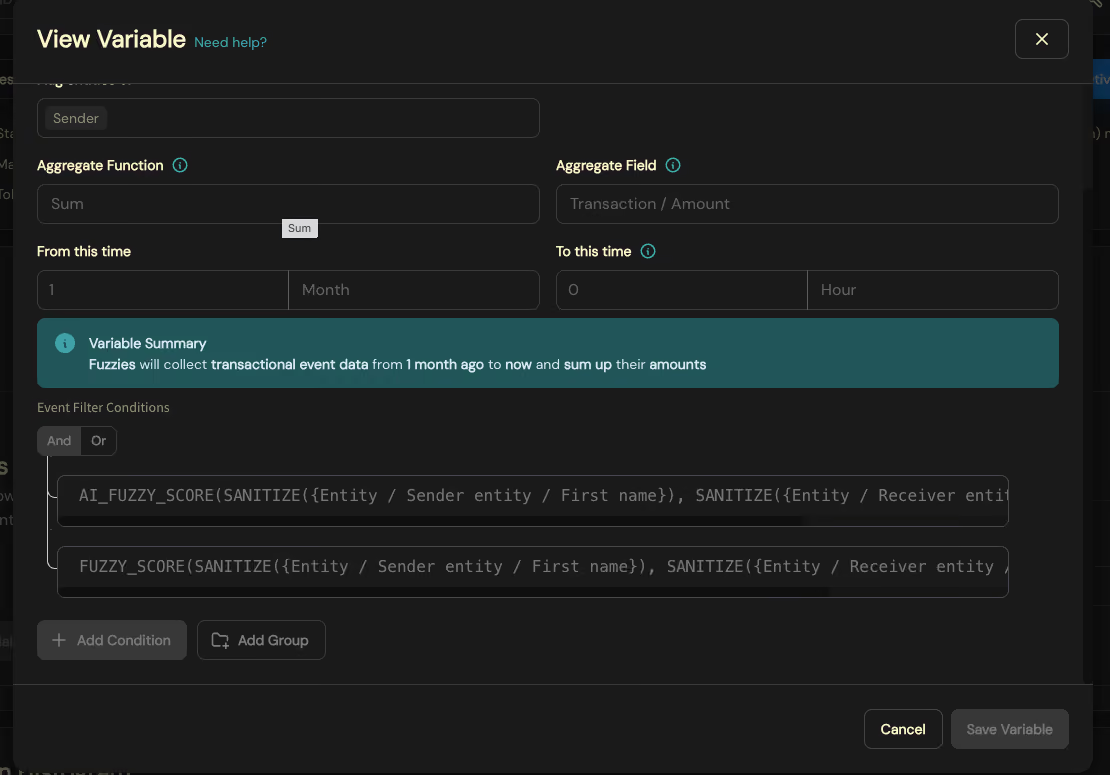
AI fuzzy matching in Unit21’s rule engine goes beyond exact or character-based matching. It compares entities semantically, detecting similar names, related parties, and hidden connections that string-based logic would miss entirely.
The implications are significant for both fraud and compliance.
For fraud teams, entity resolution, correctly identifying when two names in a transaction refer to the same real-world party, is a core challenge in detecting account fraud, synthetic identity, and mule networks. Rules that only match exactly will always miss the connections that matter most: shell companies with name variations, mule accounts using slight aliases, and counterparties operating under related but distinct entity names.
For AML compliance, this is even more pressing. Beneficial owners are listed differently across jurisdictions. Sanctions targets operate under aliases. Screening against OFAC, UN, and EU watchlists requires catching semantic connections, not just exact character matches. A rule that only catches “Meta Platforms Inc.” will miss “Facebook Ireland Limited.” That’s a compliance gap, not just an operational one.
By embedding AI directly into rule logic as a callable function, Unit21 brings semantic intelligence to detection without requiring analysts to build custom ML models or interpret opaque risk scores. The logic stays in the rule. The analyst stays in control.
Detection logic that finally keeps up
Each capability targets a different failure point in the detection lifecycle:
Text-to-rule generation removes the friction between identifying a pattern and turning it into live detection logic, cutting the time from insight to rule from days to minutes.
Agentic rule optimization closes the feedback loop between investigation outcomes and rule quality, so detection logic improves continuously rather than decaying silently between manual reviews.
AI embedded in rule logic makes every rule smarter about real-world entity data, catching connections that exact matching structurally cannot.
For fraud teams, this means faster response to emerging patterns, fewer false positives blocking legitimate customers, and detection that keeps pace with organized attacks.
For compliance teams, it means more defensible detection logic, audit-ready explanations for every rule, and AML screening that can find the semantic connections regulators expect.
Together, these aren’t three disconnected features. They’re a coherent approach to the same underlying problem: detection logic that can’t keep pace with how financial crime actually operates. The teams winning at fraud and compliance prevention aren’t waiting for their rules to be broken before tuning them. They’re using AI to make rule creation faster, rule optimization continuous, and rule logic semantically aware.
See it in action: upcoming webinar
The fastest way to understand how these capabilities work in practice is to see them live. Our upcoming webinar, AI Risk Infrastructure in Action: How Unit21 Runs the Full Financial Crime Lifecycle, walks through how modern fraud and compliance teams apply AI across the full detection and investigation workflow, end to end.
Frequently asked questions
Does AI replace rules-based detection?
No, and it shouldn’t. Rules provide transparency, auditability, and analyst control that pure ML models can’t match in compliance-regulated environments. AI makes rules faster to create, easier to optimize, and more powerful at matching. The two are complementary — Unit21’s position is that AI + rules is a fundamentally better third path than rules alone or ML alone.
Do these capabilities work for both fraud and AML compliance?
Yes. Text-to-rule generation, agentic optimization, and AI fuzzy matching apply across fraud typologies (account takeover, synthetic identity, mule networks, APP fraud) and compliance use cases (AML transaction monitoring, sanctions screening, typology-based rule tuning). The rule engine is unified across both programs.
How does agentic rule optimization handle regulatory requirements?
All rule changes surface as recommendations with clear justification. Analysts review and approve before anything changes in production. Full audit trails are preserved throughout — every recommendation is tied to the investigation evidence it came from, which means every change is defensible in an exam.
What happens when AI fuzzy matching returns uncertain results?
AI fuzzy matching can be configured to return match confidence levels, allowing rules to route uncertain cases to analyst review rather than auto-actioning them. The analyst stays in control of how uncertain matches are handled.
How is this different from adding AI on top of an existing rules engine?
Most approaches bolt AI on top of existing detection infrastructure as a separate scoring layer. Unit21 embeds AI directly into the rule engine — in rule creation, in rule optimization, and in rule logic itself. That means AI operates where detection actually happens, not as an afterthought that produces a separate score, your rules then have to interpret.

Gal Perelman is the Product Marketing Lead at Unit21, where she spearheads go-to-market strategies for AI-driven risk and compliance solutions. With over a decade of experience in the fintech and fraud sectors, she has led high-impact launches for products like Watchlist Screening and AI Rule Recommendations.
Previously, Gal held marketing leadership roles at Design Pickle, Sightfull, and Lusha. She holds a Master’s degree from American University and a Bachelor’s from UCLA, and is dedicated to helping banks and fintechs navigate complex regulatory landscapes through innovative technology.