
How Unit21’s Flat File Ingestion Protocol (FFIP) Transforms FrAML

Switching to a new FrAML system doesn’t have to be overwhelming. Many financial institutions want better tools but worry about long timelines, data issues, and the strain on their compliance teams. Unit21’s Flat File Ingestion Protocol, or FFIP, was created to make that process easier to help compliance teams move faster and with far less stress.
Why Switching FrAML Systems Feels Risky, But Doesn’t Have to Be
For financial institutions, switching technology providers is a high-stakes decision, especially when it involves major FrAML migration efforts and core fraud and AML platforms. These tools are tightly woven into everyday operations, and any disruption can have a cascading effect across compliance, risk management, and customer experience.
Many institutions stick with outdated tools not because they’re satisfied, but because past migrations have been painful, resource-draining, and slow. They remember the last time it took 12 months to stand up a system, and they're not eager to repeat the experience.
Common concerns we hear include:
- Can the new system work with our core banking platform?
- Will we lose our existing detection rules and workflows?
- How much internal engineering support will this take?
- How long until we’re live and compliant again?
At Unit21, we believe switching shouldn’t come with that kind of baggage. Our Flat File Ingestion Protocol (FFIP) is built to de-risk migration and drastically shorten the path to value. Here’s how.
The Real Data Challenge in Financial Institutions
Behind every FrAML system is a web of AML data ingestion pipelines. Financial institutions operate in fragmented environments, juggling data from core banking systems, payment processors, online banking platforms, and third-party services, like OFAC screening or credit score providers. This creates enormous financial data ingestion challenges.
This data is messy: different formats, structures, and update cadences. You’ll find CSVs, NACHA files, X9 check image files, pipe-delimited text files, and proprietary formats that haven’t changed in decades.
What’s worse, the teams responsible for compliance and fraud prevention rarely have dedicated engineering resources to handle all this complexity. They end up relying on cross-functional help, external vendors, or outdated workflows just to get data from point A to point B.
That’s not just inefficient, it’s risky. Delayed data access means slower detection and more exposure.
Unit21 understands this. That’s why we designed our ingestion system to work with the chaos, not against it.
Why the Flat File Ingestion Protocol Cuts ETL Bottlenecks
Most traditional FrAML tools rely on a rigid ETL (Extract, Transform, Load) model, which slows FrAML implementation timelines. Before any data enters the system, it must be transformed to match the vendor’s schema. That means upfront engineering work, often weeks or months of mapping, cleaning, deduplication, and reformatting.
This setup creates a bottleneck. Institutions can’t start using their new tools until every transformation is dialed in. And every change to upstream systems requires rework.
Unit21 takes a different approach. Our model flips the script to ELT: Extract, Load, Transform. You load the raw data first; no need to conform to a rigid structure upfront. Then the transformation occurs within the platform.
This means:
- Faster onboarding: get data into the system sooner
- More flexibility: iterate and refine mappings without reloading files
- Less burden on engineering teams: empower compliance and ops teams to handle updates
This isn’t just a technical improvement. It’s a strategic one, enabling FIs to adapt faster, stay compliant, and respond to fraud in real time.
Introducing Unit21’s Flat File Ingestion Protocol (FFIP)
To modernize data ingestion for financial institutions, we built Unit21 FFIP (Flat File Ingestion Protocol). FFIP enables clients to send raw data from their existing systems using flat files, including formats they already generate for legacy vendors.
FFIP supports a wide range of file types, including:
- CSV files
- Text files (.txt)
- Pipe-delimited files
- NACHA files for ACH transactions
- X9 files for check images
- Wire transfer files
This compatibility means institutions don’t have to reinvent the wheel. They can reuse existing files and formats, reducing integration timelines by months. FFIP simplifies the process to a single ask at the start, just the file extracts. No need to force conformance to a strict API from day one.
By reducing friction, FFIP gives institutions a head start on implementation, whether they’re replacing legacy systems or building new FrAML workflows from scratch.
Flexible Mapping and Transformations Without Engineers
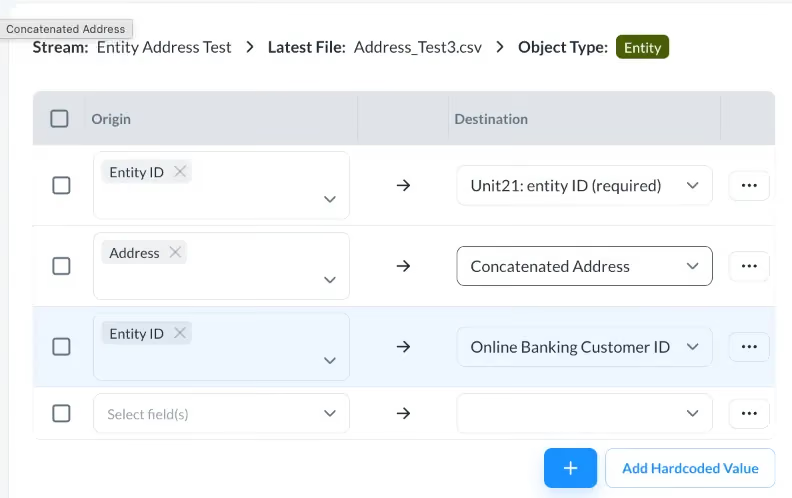
Once data is loaded into Unit21 using FFIP, the real power begins. Clients can map data fields to match their operational and compliance needs directly within the platform. There’s no need to fit a rigid schema or work through long technical cycles.
Want to add custom fields? No problem. If your institution tracks both a “Member Number” and a distinct “Online Banking ID,” both can be captured and associated with the same customer profile. This ensures consistency across your internal systems and improves auditability.
Data transformation is equally intuitive. Need to strip leading zeros from transaction IDs or normalize account numbers? You can do it with built-in tools, no coding required. Simple regex transformations, field formatting, and conditional logic can be configured directly in the interface by your compliance or operations team.
With FFIP, you keep control of your data and eliminate the delays tied to engineering backlogs. It’s a self-service model designed for the people who use the system every day.
Faster FrAML Implementations With the Unit21 FFIP
Unit21’s FFIP does more than make onboarding easier; it shortens the path to results. Traditional FrAML implementations can take months to go live. With FFIP, many institutions begin testing and fine-tuning in a matter of weeks.
Faster implementations directly improve financial crime prevention workflows. The sooner a FrAML system is live, the sooner it can:
- Detect fraudulent behavior
- Surface suspicious activity
- Satisfy regulatory reporting
- Support internal investigations
Institutions don’t just save time; they gain a faster return on investment. In one example, Service Credit Union dramatically cut its deployment timeline using FFIP, enabling its team to move from implementation to insight much faster.
Speed is not just a convenience. It is a competitive advantage when it comes to financial crime detection and compliance.
Simpler Integration, Stronger FrAML
Switching FrAML systems should not come at the cost of speed, flexibility, or operational sanity. Unit21’s Flat File Ingestion Protocol simplifies what is traditionally the most painful part of any implementation. It meets institutions where they are, using the data they already have, and puts control in the hands of the people who need it most.
With FFIP, institutions can go from plan to production faster, with less overhead and more agility. Whether you’re replacing legacy tools or scaling to support new lines of business, FFIP offers a proven path forward.
Want to See Unit21 FFIP in Action?
If you're planning a FrAML migration or looking for a simpler way to manage data ingestion, Unit21’s Flat File Ingestion Protocol can help your team move faster with less effort. Request a demo to see how Unit21 FFIP can streamline your implementation and strengthen your fraud and AML operations.
Dhiraj Bhat is a Product Manager at Unit21 and a member of the Forbes Business Development Council. As the company's first product hire, he has been central to launching core infrastructure, including Identity Verification and Regulatory Reporting solutions.
Dhiraj currently leads the Unit21 Fraud Consortium, a collaborative network of over 100 institutions dedicated to stopping fraud before money moves. With a Master’s from Duke University and a focus on Generative AI, he specializes in transforming complex risk operations into seamless, no-code experiences for fraud fighters.